
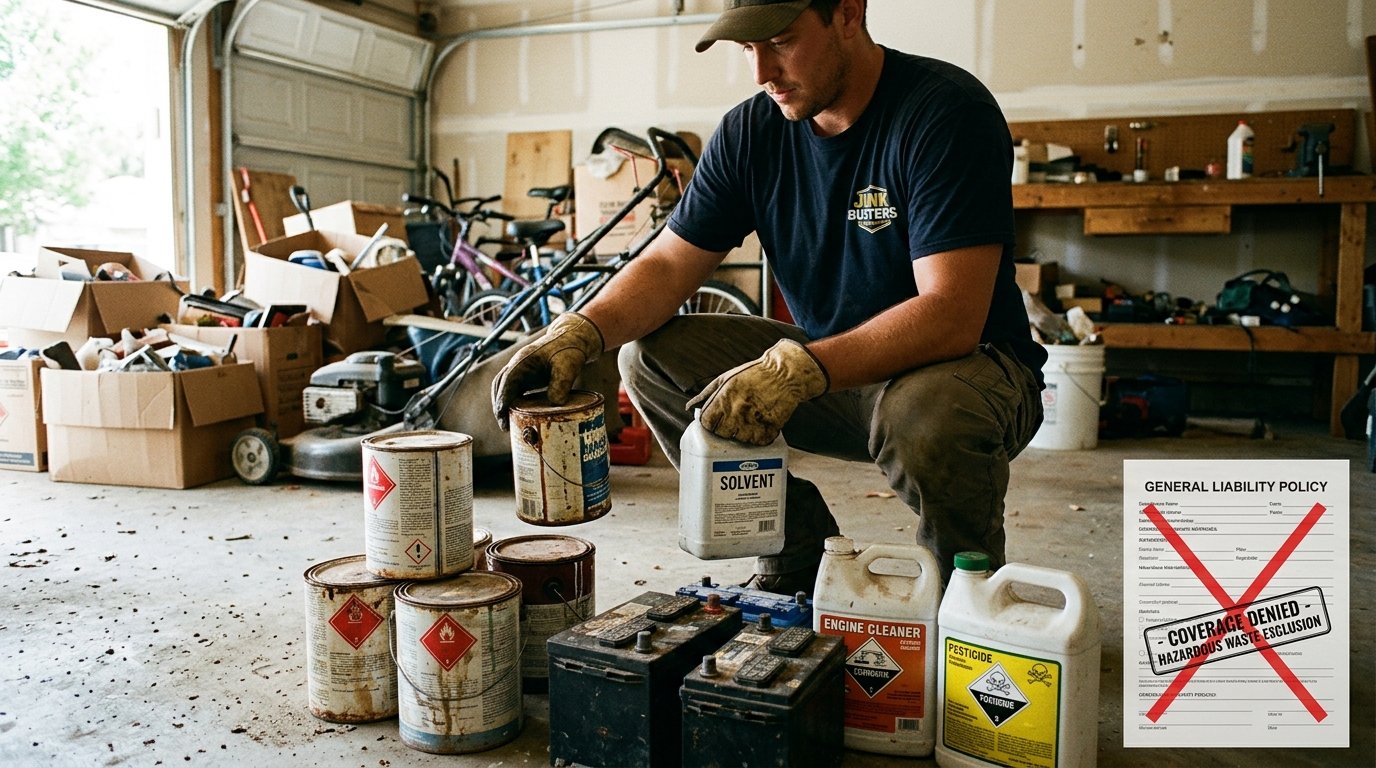
Most junk removal operators have insurance. Most also have at least one coverage gap that would cause a claim to be denied and they have no idea until it happens on a job.
Getting the right insurance for junk removal business means understanding what your standard policies exclude. Two exclusions catch operators off guard constantly and this guide explains both.
General liability is the first policy every junk removal business buys. It is also the policy most likely to deny a claim in this industry due to two standard exclusions most brokers never explain upfront.
Standard GL policies exclude damage to property in your possession. In junk removal that is a direct problem because everything you touch on a job is technically in your care custody and control.
If your crew scratches a hardwood floor hauling out a refrigerator or damages items a customer wanted to keep, your standard GL may deny the claim. The fix is a CCC endorsement added to your GL policy for $200 to $500 per year.
Every standard GL and commercial auto policy issued since the mid-1980s contains a pollution exclusion. For junk removal this matters because estate cleanouts, garage cleanouts and commercial jobs routinely involve paint cans, solvents, old batteries and chemicals.
If a crew member punctures a solvent container during a cleanout and it seeps into a client’s flooring, your GL will not cover cleanup costs or the resulting liability claim. Separate pollution liability costs approximately $1,680 per year and is essential for any operator handling residential estate or commercial cleanouts.
Covers third-party bodily injury and property damage during operations. A homeowner tripping over equipment, a crew member dropping furniture onto a client’s vehicle or damage to a neighboring property all fall under general liability.
Industry standard is $1 million per occurrence and $2 million aggregate. Most commercial clients and municipalities will not contract below this threshold. Average cost runs $500 to $1,500 per year.
Legally required in every US state for vehicles used in business. Personal auto policies exclude commercial use entirely and any claim will be denied if your driver causes an accident en route to a job.
Average cost runs $1,500 to $4,000 per vehicle annually. Operators running tri-axle dump trucks should review our tri-axle dump truck insurance guide for weight-class specific requirements.
Refuse collection is the fourth deadliest job in the US with an injury rate more than double the national average. Back strains, cuts from debris and falls are daily risks for any hauling crew.
Required in almost every state the moment you hire an employee. Average cost runs $1,000 to $3,500 per year and one uninsured injury claim can exceed years of premium costs.
Standard policies do not cover handheld tools, dollies and straps against theft or damage. This is typically added as a low-cost endorsement to a BOP.
Pollution Liability If you handle estate or commercial cleanouts this is non-negotiable. Standard GL excludes all chemical and solvent incidents on job sites. Approximately $1,680 per year.
Commercial Umbrella Commercial clients increasingly require $2 million or more per occurrence. An umbrella adds $1 million above existing limits at lower cost than restructuring your base GL.
When you bid on property management or municipal cleanup contracts clients check four things:
Missing the additional insured endorsement is the most common reason operators lose commercial contracts at the final step.
For operators running multiple truck types our guides on flatbed truck insurance and towing company insurance cover multi-vehicle policy structures. Our commercial trucking insurance guide covers fleet coverage across mixed vehicle types.
| Coverage | Average Annual Cost |
| General Liability | $500 to $1,500 |
| Commercial Auto (per vehicle) | $1,500 to $4,000 |
| Workers’ Compensation | $1,000 to $3,500 |
| Pollution Liability | $1,680 |
| Full Package (small operator) | $3,000 to $8,000 |
Solo operators typically pay $3,000 to $5,000 annually for a complete stack. Companies with five or more trucks pay $8,000 to $30,000 depending on fleet size and contract type.
Our temporary commercial vehicle insurance guide covers part-year structures for seasonal operators. Gooseneck trailer users should review our gooseneck trailer insurance guide for towed unit requirements. Mobile food vendors can compare policy structures in our food truck business insurance guide.
What is the most important insurance for a junk removal business? General liability and commercial auto are the minimum. Add a CCC endorsement immediately since standard GL excludes property damage during removal jobs.
Does general liability cover damage to a customer’s property? Not automatically. A CCC endorsement at $200 to $500 per year fixes this standard exclusion.
Do I need pollution liability for junk removal? Yes, if you handle estate or commercial cleanouts. Paint, batteries and solvents are common and standard GL excludes all pollution incidents.
How much does junk removal insurance cost per month? Solo operators pay roughly $250 to $420 per month for a full coverage stack.
Can I get same-day coverage? Yes for standard policies. Allow one to two business days for additional insured endorsements.
The operators who face denied claims are not uninsured. They bought standard policies without understanding the two exclusions that make those policies fail in junk removal specifically. Fix the CCC gap. Address the pollution exclusion. Get your commercial auto structured correctly.
Call (866) 757-5350 to speak with a licensed specialist who identifies your coverage gaps and builds a policy stack that holds up when you need it.