By [Ayesha], Licensed Commercial Insurance Specialist | Updated: February 2026 | 12 min read
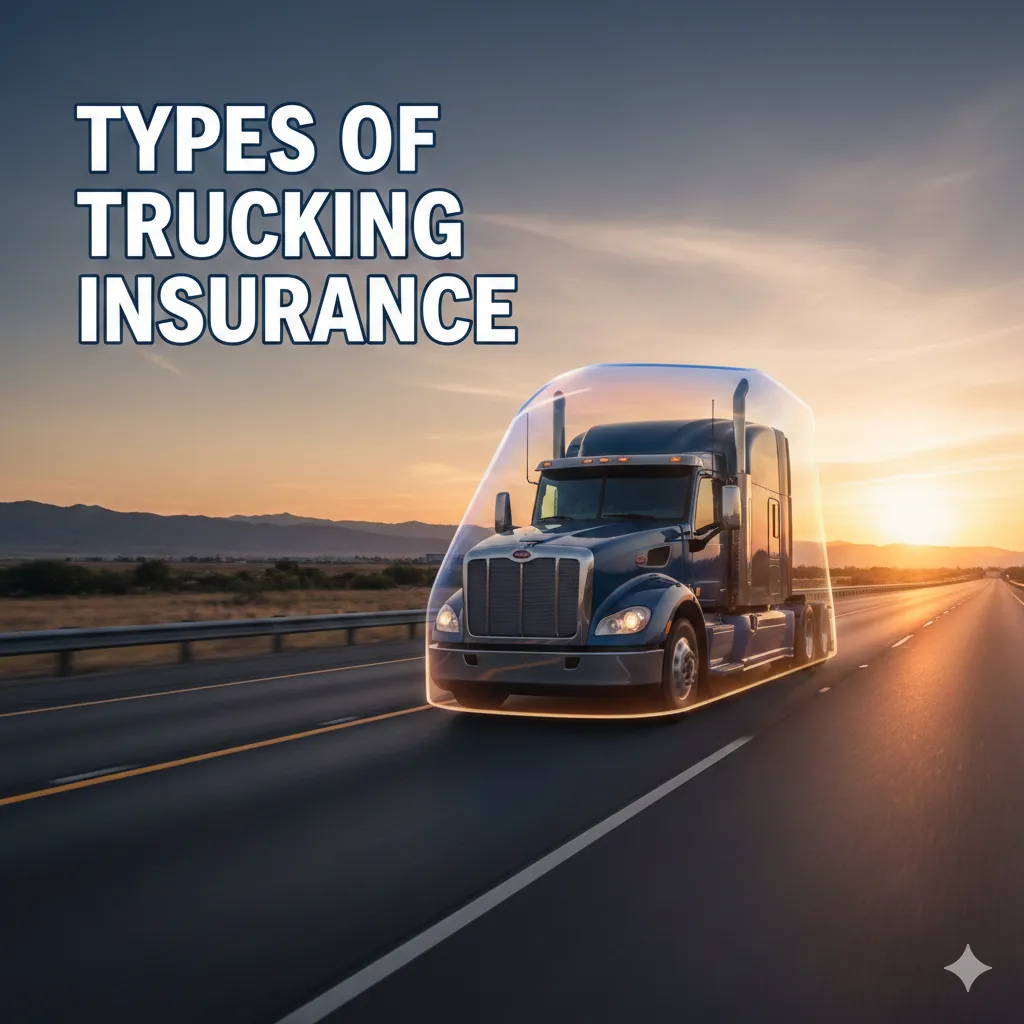
Commercial trucking isn’t like driving a personal vehicle. The risks are bigger, the regulations are stricter, and a single accident can produce a multi-million dollar lawsuit. That’s why trucking insurance isn’t a single policy — it’s a layered system of coverages, each one protecting a different piece of your operation.
Whether you’re a first-time owner-operator trying to figure out what you actually need, a fleet manager reviewing your current policy, or a carrier researching your FMCSA filing requirements, this guide breaks down every type of commercial trucking insurance in plain English — what it covers, who needs it, and what it typically costs.
📋 In This Guide
A personal auto policy covers your car, your liability, and that’s about it. Commercial trucking doesn’t work that way. When you haul freight across state lines, operate a $200,000 semi-truck, and face federal FMCSA regulations, one policy cannot do everything.
The commercial trucking insurance market is designed around specific exposures: the truck itself, the freight inside it, your liability to third parties, your liability when you’re not hauling, and your responsibility to your drivers. Each of these exposures has its own dedicated coverage type — and understanding all of them is the difference between being properly protected and having catastrophic gaps in coverage.
⚠️ Federal Requirement Notice
The FMCSA requires all for-hire motor carriers operating in interstate commerce to carry minimum primary liability insurance.
Limits: $750,000 (general freight) | $1,000,000 (oil/hazardous materials) | $5,000,000 (hazmat/radioactive)
Failure to maintain required filings (Form MCS-90) can result in USDOT operating authority suspension.
01 Primary (Trucking) Liability Insurance
The foundational, federally required coverage every commercial truck must carry
Primary liability is the cornerstone of any commercial trucking insurance program. It’s the coverage that protects you financially when your truck is involved in an accident that injures another person or damages someone else’s property — and it’s required by federal law for all for-hire carriers.
Primary trucking liability insurance operates exactly like commercial auto liability: if your driver causes an accident, this coverage pays for the other party’s medical bills, lost wages, vehicle repairs, legal defense costs, and settlements up to your policy limit.
✅ Pro Tip
Ask your agent whether your primary liability policy includes a Form MCS-90 endorsement. This federally mandated endorsement guarantees payment to third parties even if your policy has lapsed — and the FMCSA requires it be on file before you can operate legally.
02 Motor Truck Cargo Insurance
Protection for the freight you’re hauling — required by most shippers and brokers
You’re responsible for the freight in your trailer from the moment you take possession of it to the moment it’s delivered. If that cargo is lost, stolen, or damaged while in your care, the shipper or freight broker can hold you financially liable — and the costs can be significant.
Motor truck cargo insurance (also called cargo insurance or freight insurance) covers the goods you’re transporting against loss, damage, theft, and certain accidents. It’s not technically required by federal law, but virtually every shipper and freight broker will require proof of cargo coverage before they load your truck.
✅ Pro Tip
Different commodities have dramatically different cargo insurance costs. Hauling electronics, pharmaceuticals, or alcohol costs significantly more to insure than general freight. Always disclose your commodity types accurately — misrepresentation can void your coverage at claim time.
03 Physical Damage Insurance
Collision + Comprehensive — covers repairs or replacement of your own truck
Primary liability protects other people from your truck. Physical damage insurance protects your truck itself. If you own a semi that’s worth $80,000, $120,000, or more, a single accident without physical damage coverage could put you out of business overnight.
Physical damage is actually two coverages bundled together: Collision (damage from accidents) and Comprehensive (damage from everything else — theft, fire, hail, vandalism, flood, hitting an animal). Most lenders and lease companies require both if you’re financing your truck.
✅ Pro Tip
If your truck is older and fully paid off, run the numbers before buying physical damage. If the truck is worth $15,000 and physical damage costs $2,500/year with a $2,500 deductible, it may not be worth the premium. Work with your agent on this calculation.
04 Bobtail / Non-Trucking Liability Insurance
Coverage for when you’re driving your truck without a load or without dispatch authorization
Here’s a coverage gap that surprises many owner-operators: your primary trucking liability insurance only covers you when you’re operating under a motor carrier’s authority — meaning when you have a loaded trailer and are on a dispatched trip. The moment you unhook that trailer and drive home, or run a personal errand in your truck, your primary liability coverage stops.
That’s exactly what bobtail insurance (also called non-trucking liability or deadhead coverage) addresses. It covers you during those personal-use or non-dispatch moments when your carrier’s primary policy doesn’t apply.
✅ Pro Tip
Review your lease agreement carefully. Some carriers extend their primary liability coverage to owner-operators even when off dispatch. If yours does, you may not need separate bobtail coverage. If it doesn’t, this is a non-negotiable gap-filler.
05 General Liability Insurance for Trucking
Business liability coverage beyond your truck’s auto policy
Many truckers assume that primary (auto) liability covers all their business liability exposures. It doesn’t. Primary trucking liability covers accidents involving your truck on the road. General liability insurance covers the business liability situations that happen everywhere else.
Consider a few common scenarios: a shipper’s employee trips over your equipment at the loading dock, you accidentally damage a customer’s warehouse door during delivery, a lawsuit claims false advertising in your trucking business materials, or someone is injured at your business premises. None of those are covered by your auto policy. All of them would be covered by commercial general liability.
06 Trucking Umbrella / Excess Liability Insurance
Extra liability protection above your primary policy limits when a single accident exceeds your coverage
Nuclear verdicts — jury awards exceeding $10 million — have become increasingly common in trucking litigation. A serious accident involving multiple fatalities can easily generate claims that dwarf a $1 million liability policy. Umbrella and excess liability insurance exist precisely for these catastrophic scenarios.
An umbrella policy sits on top of your primary liability (and often your GL and employers liability) and kicks in once the underlying policy limits are exhausted. It provides a critical financial buffer against runaway litigation that could otherwise destroy a trucking business entirely.
✅ Pro Tip
The trucking litigation landscape has changed dramatically. Settlement and verdict averages for serious trucking accidents have climbed into the millions. Carriers and owner-operators with only minimum liability limits are one bad accident away from personal financial ruin. An umbrella policy is cheap protection against catastrophic loss.
07 Occupational Accident Insurance
Income and medical protection for independent contractor drivers — the alternative to workers’ comp
Most owner-operators and independent contractors (1099 drivers) are not eligible for traditional workers’ compensation insurance — that’s an employee benefit. But that doesn’t mean you have no protection if you’re injured on the job. Occupational accident insurance (occ/acc) fills that gap for independent truckers.
Occ/acc is a voluntary benefit that provides medical expense coverage, disability income, and accidental death benefits if you’re injured while working as a trucker. It’s not a perfect substitute for workers’ comp — it has limits and exclusions — but it’s the best protection available for independent contractors who are ineligible for state workers’ comp systems.
✅ Pro Tip
Many carriers require owner-operators to provide proof of occupational accident coverage before allowing them to lease on. Always check your leasing agreement and confirm whether you need to purchase your own occ/acc policy or if the carrier provides it.
08 Workers’ Compensation for Trucking Companies
Required protection for employees injured on the job — mandatory in most states for motor carriers with employees
If you operate a trucking company with W-2 employees — company drivers, dispatchers, mechanics, or any staff — workers’ compensation insurance is not optional. Most states require it by law, and the FMCSA‘s safety regulations strongly encourage it. Failing to carry workers’ comp when required can result in massive fines, personal liability for the employer, and state operating penalties.
Workers’ compensation covers your employees for injuries sustained while working, regardless of fault. It pays medical bills, partial wage replacement during recovery, rehabilitation costs, and death benefits. It also protects the employer from employee lawsuits related to workplace injuries.
✅ Pro Tip
Owner-operators with no employees can often legally opt out of workers’ comp in most states and use occupational accident insurance instead — at significant cost savings. Work with your insurance agent and consult your state’s workers’ comp board to confirm your eligibility and requirements.
09 Trailer Interchange Insurance
Coverage for non-owned trailers you’re using under a trailer interchange agreement
In the modern trucking industry, it’s common for carriers to pull trailers owned by other carriers — especially in intermodal operations, drop-and-hook freight, and dedicated lane contracts. When you’re pulling someone else’s trailer, your physical damage policy typically won’t cover damage to that trailer because you don’t own it.
Trailer interchange insurance fills this gap. It provides physical damage coverage for a non-owned trailer while it’s in your possession under a formal trailer interchange agreement. This is a specific type of coverage that applies only when there’s a documented legal exchange of trailers between carriers.
10 Reefer Breakdown Insurance
Specialized coverage for refrigerated units — protects against cargo spoilage due to mechanical failure
Refrigerated freight — food, pharmaceuticals, medical supplies, floral, and other temperature-sensitive goods — represents a premium segment of trucking. But hauling reefer freight comes with a specialized risk that standard cargo insurance doesn’t cover: mechanical breakdown of the refrigeration unit itself.
Standard cargo insurance covers cargo damage from accidents, theft, and fire. But if your refrigeration unit breaks down mid-route and your load of produce or frozen goods spoils, that’s typically excluded from standard cargo coverage. Reefer breakdown insurance specifically addresses this gap.
✅ Pro Tip
Always document pre-trip reefer pre-cooling, continuous temperature logs during transit, and post-delivery temperature records. In a reefer breakdown claim, thorough documentation is the difference between a paid claim and a disputed one.
Use the table below to quickly identify which coverages apply to your operation:
| Coverage Type | What It Protects | Required? | Avg. Annual Cost | Owner-Op Needed? |
| Primary Liability | Others injured/property damaged by your truck | Yes (FMCSA) | $5K–$15K+ | Yes |
| Motor Truck Cargo | Freight you’re hauling | Contractually required | $1.5K–$4K | Yes (if for-hire) |
| Physical Damage | Your truck (collision + comprehensive) | If financed | $2K–$6K | Recommended |
| Bobtail / NTL | Your liability off-dispatch | No (but critical gap) | $400–$1.2K | If leased to carrier |
| General Liability | Premises & non-auto business liability | Often contractual | $1.2K–$3.5K | Recommended |
| Umbrella / Excess | Extra liability above primary limits | No (but wise) | $2K–$8K | Recommended |
| Occupational Accident | Your injuries as an IC (1099) | No (replaces WC) | $1.5K–$3.5K | If no WC coverage |
| Workers’ Compensation | Employee injuries | Yes if W-2 employees | Varies by payroll | If you have employees |
| Trailer Interchange | Non-owned trailer physical damage | Per interchange agreement | $500–$2K | If pulling others’ trailers |
| Reefer Breakdown | Spoilage from reefer unit failure | No (reefer carriers only) | $500–$2.5K | If hauling perishables |
Now that you understand each coverage type, the natural question is: which ones do I actually need? The answer depends on your operation type, truck ownership, business structure, and the freight you haul. Here’s a practical framework:
When you’re leased to a motor carrier, their primary liability insurance typically covers your truck while you’re on dispatch. But there are still critical gaps you need to fill yourself:
Operating under your own MC authority means you’re responsible for everything. A complete coverage stack looks like this:
Fleet operations add complexity. You’re responsible for multiple trucks, multiple drivers, and potentially a mix of company drivers and leased owner-operators. Your coverage stack should include:
🔑 Key Takeaways
✔ Primary liability is legally required — there’s no operation without it.
✔ Cargo insurance is required by almost every shipper and freight broker.
✔ Physical damage protects your most valuable business asset — your truck.
✔ Bobtail coverage closes the gap when you’re off dispatch.
✔ Occupational accident is the independent contractor’s substitute for workers’ compensation.
✔ Umbrella coverage is the most underused protection against catastrophic, business-ending verdicts.
✔ Reefer breakdown and trailer interchange are specialty coverages for specific operations.
⚠️ Avoid These Costly Coverage Gaps
Trucking insurance comes with its own vocabulary. Here are the most important terms you’ll encounter when shopping for coverage:
| Term | What It Means |
| FMCSA | Federal Motor Carrier Safety Administration — the agency that regulates interstate trucking and sets minimum insurance requirements |
| Form MCS-90 | A mandatory endorsement filed with the FMCSA confirming your carrier meets minimum liability requirements |
| BMC-91 / BMC-91X | FMCSA forms filed by insurance companies confirming continuous liability coverage to the federal government |
| Motor Carrier Authority | Your federal operating license (MC number) — required for interstate for-hire trucking |
| USDOT Number | Your unique identifier in the FMCSA system — required before you can apply for MC authority |
| Deductible | The amount you pay out of pocket before insurance coverage kicks in — higher deductibles = lower premiums |
| Primary Liability | Auto liability coverage that applies while you’re operating as a for-hire carrier on dispatch |
| Non-Trucking Liability | Liability coverage that applies when your truck is being used for personal, non-business purposes |
| Stated Value | The agreed dollar amount your truck is insured for — no depreciation calculation at claim time |
| Actual Cash Value (ACV) | Market value of your truck at the time of loss, factoring in depreciation — can be significantly less than what you paid |
| Loss Payee | A party (typically a lender) listed on your physical damage policy to receive claim payments for a financed vehicle |
| Named Insured | The person or entity whose name is on the policy and who holds the coverage rights |
| Combined Single Limit (CSL) | A single liability limit that applies to both bodily injury and property damage combined — common in trucking policies |
| CSA Score | Compliance, Safety, Accountability score — FMCSA’s rating system that directly impacts your insurance eligibility and premiums |
Primary liability insurance is the most critical because it’s federally required and covers the largest financial exposure — injury and property damage to third parties. Without it, you cannot legally operate as a for-hire carrier. However, cargo insurance is equally important commercially because most shippers and brokers require it before they’ll work with you.
No. The coverages you need depend on your specific operation. Every for-hire trucker needs primary liability and cargo insurance. Physical damage is essential if your truck is financed. After that, your needs depend on whether you’re leased or under your own authority, whether you have employees, and what type of freight you haul. Work with a licensed trucking insurance specialist to identify your exact exposure profile.
Bobtail insurance specifically covers you when driving your truck without a trailer (the ‘bobtail’ position). Non-trucking liability is broader — it covers you when using your truck for personal purposes, whether or not you have a trailer attached. The key distinction is that both apply only when you’re NOT operating under a motor carrier’s authority. Check which term your state and carrier use, as they’re often used interchangeably.
Many insurance companies offer ‘trucking insurance packages’ that bundle primary liability, physical damage, and cargo together. However, some specialty coverages like occupational accident and workers’ compensation are always separate. A package policy can simplify administration and sometimes offer pricing advantages, but always verify that each coverage in the package has the limits you actually need rather than assuming one price covers everything adequately.
A high CSA score (indicating poor safety performance) doesn’t just affect pricing — it can affect availability. Carriers with high-risk BASIC scores may find that standard insurance companies won’t write their policy at all, pushing them into the excess and surplus lines (E&S) market where premiums are significantly higher and coverage terms may be less favorable. Maintaining clean safety records and managing your CSA score is one of the most powerful tools for controlling insurance costs long-term.
The cheapest approach varies based on your operation, but general strategies include: maintaining a clean driving record and CSA score, installing and using ELD and dashcam technology (which can earn discounts), choosing higher deductibles on physical damage, bundling coverages with a single carrier, working with a specialist trucking insurance broker who has access to multiple markets, and completing defensive driving or safety training programs that qualify for premium credits.
Commercial trucking insurance isn’t a commodity you buy once and forget. It’s a dynamic protection system that should evolve as your business grows — more trucks, more drivers, higher-value freight, and new contractual requirements all change what you need.
Start with what’s required: primary liability and cargo. Add physical damage to protect your equipment. Fill the gaps with bobtail, general liability, and occupational accident based on your operating structure. Then layer in umbrella coverage to protect against the lawsuits that can end a trucking business overnight.
The best thing you can do is work with a licensed commercial trucking insurance specialist — not a general insurance agent — who understands the industry, knows the FMCSA regulations, and has access to multiple markets that write trucking risks. The right coverage at the right price starts with the right advisor.
Have questions about your specific coverage needs? Contact a licensed trucking insurance specialist today for a free coverage review and quote comparison.