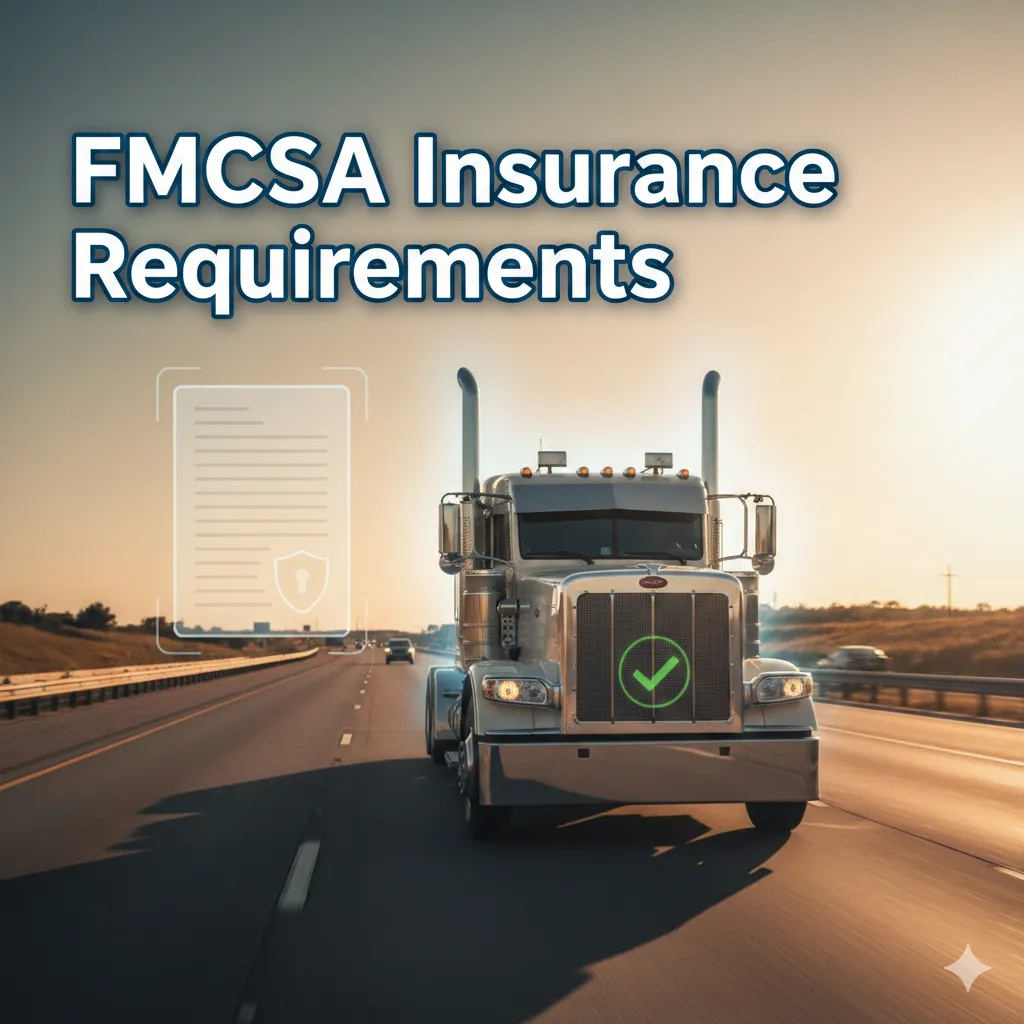
FMCSA Insurance Requirements
A complete guide to federal minimum insurance requirements for motor carriers, owner-operators, and commercial truck drivers
OLPolicy | (866) 757-5350 | Last Updated: 2026 | Reading Time: ~20 min
| Key Takeaways • The FMCSA sets mandatory minimum insurance levels for all motor carriers operating in interstate commerce as a condition of maintaining operating authority. • Primary liability minimums range from $300,000 to $5,000,000 depending on vehicle weight, cargo type, and whether you carry passengers or hazardous materials. • Proof of insurance must be filed directly with the FMCSA by your insurer using Form BMC-91 or BMC-91X a lapse triggers automatic authority suspension. • Most freight brokers and shippers require $1,000,000 in liability regardless of the FMCSA floor, making the federal minimum a legal floor, not a market standard. • Cargo insurance, physical damage, and occupational accident coverage are not federally mandated but are practically required by the freight market. • OLPolicy helps motor carriers and owner-operators meet FMCSA requirements and get competitive rates. Call (866) 757-5350 for a free compliance review. |
If you are starting a trucking business, applying for motor carrier authority, or renewing your operating authority with the Federal Motor Carrier Safety Administration, understanding FMCSA insurance requirements is not optional. Federal insurance filings are a prerequisite for active operating authority, and a lapse even a brief one can result in automatic suspension that takes you off the road until coverage is reinstated and confirmed.
Beyond compliance, FMCSA requirements represent the floor of what is legally permitted, not the ceiling of what is financially prudent. The freight market routinely demands coverage levels that exceed the federal minimum, and the financial consequences of an uninsured or underinsured accident in commercial trucking can be catastrophic for an individual operator or small carrier.
This guide walks through every layer of FMCSA insurance requirements: what they are, who they apply to, how the filing process works, what happens when coverage lapses, and how to build a compliant coverage package that also meets market expectations. For questions specific to your operation, OLPolicy’s commercial transportation specialists are available at (866) 757-5350.
The Federal Motor Carrier Safety Administration is a agency of the U.S. Department of Transportation responsible for regulating and providing safety oversight of commercial motor vehicles operating in interstate commerce. Established in 2000, the FMCSA’s mission is to reduce crashes, injuries, and fatalities involving large trucks and buses.
One of the FMCSA’s core regulatory tools is the requirement that all for-hire motor carriers maintain minimum levels of financial responsibility that is, insurance as a condition of holding active operating authority. The logic is straightforward: commercial trucks are large, heavy, and capable of causing serious harm. Requiring operators to carry insurance ensures that victims of accidents have a reliable source of compensation, and that the financial burden of a serious accident does not fall entirely on injured parties who may have no other recourse.
FMCSA jurisdiction covers motor carriers engaged in interstate commerce operations that cross state lines or involve goods that originated in or are destined for another state. This definition is broader than it might initially appear. A truck that operates entirely within a single state may still be subject to FMCSA requirements if the cargo it carries originated in another state or is part of an interstate supply chain.
The following types of operators are generally subject to FMCSA insurance requirements:
| Intrastate Operations If you operate exclusively within a single state, you may not be subject to FMCSA jurisdiction. However, most states have adopted their own minimum insurance requirements for intrastate carriers, often mirroring or exceeding federal standards. Check with your state’s Department of Transportation for state-specific requirements applicable to your operation. |
The FMCSA does not apply a single uniform insurance requirement to all motor carriers. Minimum coverage levels are tiered based on the type of operation, the weight class of the vehicle, and whether the carrier transports hazardous materials or passengers. Understanding which tier applies to your operation is the starting point for any compliance analysis.
Primary auto liability insurance which pays for bodily injury and property damage caused to third parties by your vehicle is the core FMCSA requirement. The following minimums apply under 49 CFR Part 387:
| Operation Type | Vehicle / Cargo Description | Minimum Liability Required |
| For-hire interstate carrier | Non-hazmat freight, vehicles 10,001 lbs GVWR or more | $750,000 |
| For-hire interstate carrier | Non-hazmat freight, vehicles under 10,001 lbs GVWR | $300,000 |
| For-hire interstate carrier | Oil, explosives, or certain hazardous materials | $1,000,000 |
| For-hire interstate carrier | High-risk hazardous materials (e.g., radioactive, poisonous gas) | $5,000,000 |
| For-hire passenger carrier | Vehicles with seating for 16 or more passengers | $5,000,000 |
| For-hire passenger carrier | Vehicles with seating for 8 to 15 passengers | $1,500,000 |
| Private carrier (own goods) | Non-hazmat freight, vehicles 10,001 lbs GVWR or more | $750,000 |
| Household goods mover | Interstate household goods transport | $750,000 |
| Regulatory Reference FMCSA insurance minimums are codified in 49 CFR Part 387 (Minimum Levels of Financial Responsibility for Motor Carriers). The specific minimums have not been updated since 1985, a fact that is the subject of ongoing regulatory debate given the increase in claim severity since that time. |
The FMCSA minimums described above are legal floors the absolute minimum required to hold active operating authority. They are not what the freight market expects, and in many cases they are not sufficient to cover the actual cost of a serious commercial trucking accident.
In practice, the freight market has established its own de facto standard that substantially exceeds the FMCSA minimum for most operations:
| Coverage Level | FMCSA Minimum (Non-Hazmat) | Freight Broker Standard | Large Shipper / Dedicated Contract |
| Primary Auto Liability | $750,000 | $1,000,000 (nearly universal) | $1,000,000 – $2,000,000 |
| Motor Truck Cargo | Not federally required | $100,000 (nearly universal) | $100,000 – $250,000+ |
| General Liability | Not federally required | Increasingly required | $1,000,000 per occurrence |
The practical implication is that meeting only the FMCSA minimum is not sufficient to operate effectively in today’s freight market. An owner-operator with $750,000 in primary liability technically compliant with federal law will be unable to accept loads from most brokers who require a $1,000,000 certificate of insurance. Building your coverage package around market requirements rather than regulatory minimums is the more practical approach.
Unlike most types of insurance, where proof of coverage is a certificate you provide to interested parties, FMCSA insurance compliance is managed through direct electronic filings made by your insurer to the FMCSA. You cannot file these forms yourself. They must be submitted by a licensed insurer on your behalf.
The primary FMCSA insurance filing forms for property carriers are:
For household goods movers, two additional forms apply:
Understanding the filing process helps you avoid the most common compliance pitfall the gap between when you think you are covered and when the FMCSA actually considers you compliant.
| Timing Is Critical New carriers frequently underestimate how long the authority activation process takes. From MC number application to fully active authority typically takes 20 to 25 business days when all filings are submitted promptly. Starting your insurance process at the same time as your authority application, not after, prevents unnecessary delays. Contact OLPolicy at (866) 757-5350 early in the process. |
One of the most consequential aspects of FMCSA insurance compliance is the continuous filing requirement. The FMCSA requires that your insurance filing be active and current at all times. There is no grace period for a lapse in coverage.
When an insurer cancels or non-renews a policy that has a BMC-91 filing on record with the FMCSA, the insurer is required to file a cancellation notice Form BMC-35 with the FMCSA at least 30 days before the cancellation takes effect. Upon receipt of this notice, the FMCSA begins the process of suspending the carrier’s operating authority.
If the carrier obtains new coverage and the new insurer files a replacement BMC-91 before the 30-day period expires, the authority remains active. If coverage is not replaced in time, the authority is suspended on the effective date of the cancellation, and the carrier must go through a reinstatement process which involves filing a new BMC-91, paying any applicable fees, and waiting for the FMCSA to process the reinstatement.
| The Real Cost of a Coverage Lapse • Operating authority suspended on the day coverage lapses no grace period. • Cannot legally haul freight for hire until authority is reinstated. • Reinstatement requires a new BMC-91 filing and FMCSA processing time (typically 1 to 3 business days minimum). • Lapse in coverage history is a negative underwriting signal that may result in higher rates or market declinations at reinstatement. • Any loads booked but not yet delivered during a lapse period create serious uninsured liability exposure. • Cargo claims during a lapse period may be denied entirely. |
Meeting FMCSA compliance involves more than primary liability. For most operators, a fully compliant and market-ready insurance package includes several coverage types working together. This section explains what each covers and how it relates to federal requirements.
Primary auto liability is the only coverage explicitly required by FMCSA for property carriers. It pays for bodily injury and property damage that you cause to third parties other drivers, passengers, and property owners when your vehicle is at fault in an accident.
Primary liability is the most expensive component of any trucking insurance package, and the range of premiums is wide. A new owner-operator with limited history running dry van freight under their own authority might pay $5,000 to $10,000 annually. An experienced operator with a clean record hauling general commodities might pay $4,000 to $7,000. Operators hauling hazardous materials, running high-mileage routes through high-litigation states, or with adverse loss history may pay $15,000 to $25,000 or more.
The BMC-91 filing attached to your primary liability policy is what triggers FMCSA compliance. Without this filing on record, your authority cannot be activated or maintained.
Cargo insurance is not required by FMCSA for general freight carriers, but it is required by the vast majority of freight brokers as a condition of tendering loads. For practical purposes, it functions as a market requirement even without a federal mandate.
Cargo insurance covers the freight you are transporting against loss, damage, or theft while it is in your care, custody, and control. Coverage begins when you accept the freight at origin and ends upon delivery and receipt at destination.
Standard cargo policy limits in the market range from $100,000 to $250,000 per occurrence for general freight. High-value commodity haulers electronics, pharmaceuticals, building materials, luxury goods may require higher limits specific to their load profiles.
Household goods movers are the exception to the federal non-requirement rule: they must file a BMC-34 form certifying cargo insurance with the FMCSA as a condition of operating authority. This requirement does not extend to general freight carriers.
Physical damage insurance is not required by the FMCSA, but it is almost universally required by lenders if your truck is financed. It protects your own vehicle not third parties against damage from collision, theft, fire, weather events, and other perils.
Physical damage comprises two sub-coverages: collision (damage from an accident) and comprehensive (damage from non-collision perils including theft, fire, hail, and vandalism). Lenders typically require both.
For owner-operators with paid-off equipment, physical damage is optional from a compliance standpoint but often financially essential. Replacing a modern semi-tractor can cost $100,000 to $200,000 or more. Operating without physical damage coverage means absorbing that full cost personally in the event of a total loss.
Commercial general liability (CGL) insurance covers bodily injury and property damage claims arising from your business operations that are not related to the operation of a vehicle. This includes incidents at loading docks, shipper and receiver facilities, and any other location where your business activities could result in third-party harm.
FMCSA does not require general liability. However, an increasing number of large shippers and dedicated contract operations require it as a condition of doing business. Standard limits are $1,000,000 per occurrence and $2,000,000 aggregate. Annual premiums for owner-operators typically range from $500 to $2,000.
These coverages are relevant primarily to owner-operators leased to a motor carrier. They cover liability exposure during periods when the carrier’s primary liability policy does not apply specifically, when the truck is not under an active dispatch.
Most carrier lease agreements require leased owner-operators to carry one or both of these coverages. They are not FMCSA requirements but are nearly universal lease requirements and fill a genuine coverage gap that exists for leased operators.
As self-employed individuals, owner-operators are generally not eligible for workers’ compensation insurance. Occupational accident insurance is the private market alternative that provides income replacement, medical expense coverage, and death benefits for work-related injuries.
The FMCSA does not require occupational accident coverage. Some carrier lease agreements include it as part of the lease terms; others require the owner-operator to maintain their own policy. For independent authority operators, it is entirely the owner-operator’s responsibility to obtain.
The financial consequences of a serious injury weeks or months off the road, significant medical bills, and no income replacement make occupational accident coverage one of the most important but most underutilized coverages in the trucking industry.
| Need Help Meeting FMCSA Requirements? OLPolicy’s commercial transportation specialists help motor carriers and owner-operators navigate FMCSA compliance and get the right coverage at competitive rates. We handle BMC-91 filings and work with multiple top-rated carriers. Call OLPolicy: (866) 757-5350 | Visit: OLPolicy.com |
Transporting hazardous materials subjects a carrier to significantly elevated FMCSA insurance requirements, along with a separate and extensive regulatory framework under the Pipeline and Hazardous Materials Safety Administration (PHMSA). Insurance minimums for hazmat operations are among the highest in the trucking industry, and the underwriting process is correspondingly more rigorous.
| Hazardous Material Category | Examples | Minimum Liability Required |
| Division 1.1, 1.2, or 1.3 Explosives | Detonators, ammunition, fireworks | $5,000,000 |
| Poison gas (Division 2.3) | Chlorine, hydrogen cyanide | $5,000,000 |
| High-level radioactive materials | Spent nuclear fuel, irradiated reactor components | $5,000,000 |
| Hazardous waste (any quantity) | Industrial chemical waste, contaminated materials | $5,000,000 |
| Methane or natural gas (bulk) | Compressed or liquefied in bulk containers | $5,000,000 |
| Other hazardous materials (bulk) | Flammable liquids, corrosives, compressed gases | $1,000,000 |
| Non-bulk hazmat shipments | Small quantity hazmat in standard packaging | $1,000,000 |
Beyond elevated insurance minimums, hazmat carriers face additional federal requirements:
| Hazmat Insurance Market The standard commercial trucking insurance market has limited appetite for hazmat risks, particularly for carriers hauling Division 1 explosives, poison gas, or high-level radioactive materials. Most hazmat carriers are placed in the surplus lines or specialty markets, where premiums are higher and underwriting requirements are more intensive. OLPolicy works with specialty hazmat markets and can help you find compliant coverage. Call (866) 757-5350. |
Motor carriers transporting passengers face some of the highest FMCSA insurance minimums, reflecting the elevated liability exposure associated with transporting people rather than property.
| Passenger Vehicle Type | Seating Capacity | Minimum Liability Required |
| For-hire bus or motorcoach | 16 or more passengers (including driver) | $5,000,000 |
| For-hire van or small bus | 9 to 15 passengers (including driver) | $1,500,000 |
| Charter and tour operators | Any for-hire passenger operation | Applies per above capacity tiers |
| School bus contractors (interstate) | Any for-hire student transport | $5,000,000 (most states) |
Passenger carrier insurance requirements are among the most heavily scrutinized in the commercial vehicle industry. In addition to the FMCSA minimums, many state public utility commissions and transportation network companies impose higher requirements. Passenger carriers should work with an insurance specialist familiar with both federal and applicable state requirements for their specific routes and operations.
Obtaining a new motor carrier authority involves a specific sequence of steps, and insurance plays a critical role at multiple stages. Understanding the timeline and the filing requirements prevents the most common cause of delayed authority activation: incomplete or late insurance filings.
| Stage | Action Required | Typical Timeframe |
| 1. Apply for MC number | Submit application through FMCSA Unified Registration System | Day 1 |
| 2. Receive MC number | FMCSA assigns pending MC number | Same day – 1 business day |
| 3. 20-day protest period | FMCSA publishes notice; existing carriers may protest | 20 calendar days from publication |
| 4. Purchase insurance | Obtain qualifying primary liability policy from licensed insurer | Begin immediately; don’t wait for protest period to end |
| 5. BMC-91 filed by insurer | Insurer electronically files Form BMC-91 with FMCSA | Within 1–2 business days of policy binding |
| 6. BOC-3 filed | Process agent files Form BOC-3 designating process agents in all states | Typically same day if using an agency service |
| 7. Authority activated | FMCSA confirms all filings and activates authority | 1–3 business days after all filings received |
| Total timeline | Application to active authority (all filings on time) | Typically 21–25 business days |
The majority of new authority delays are caused by one of four issues:
New motor carrier authorities are subject to heightened scrutiny by the FMCSA for the first 18 months of operation. During this period, the carrier’s safety performance is monitored, and a poor safety rating can result in the authority being placed out of service.
From an insurance perspective, the new authority period is also when rates are highest and market access is most limited. Standard market carriers the larger, well-known commercial insurers typically require two to three years of operating history before they will consider a new authority at their preferred rates. Most new authorities are initially placed in the non-standard or surplus lines market, where rates are higher but coverage is available.
Working with a specialty trucking insurance broker who has relationships with markets that actively write new authorities is essential during this period. OLPolicy specializes in new authority placements and can help you find compliant coverage from day one. Call (866) 757-5350.
| Starting a New Trucking Authority? Call OLPolicy First. OLPolicy specializes in new motor carrier authority insurance. We handle your BMC-91 filing, work with markets that actively write new authorities, and get your coverage in place so your authority activates on time. Call OLPolicy: (866) 757-5350 | Visit: OLPolicy.com |
The FMCSA takes insurance compliance seriously, and the consequences of operating without required coverage are severe at multiple levels: federal regulatory, financial, and civil liability.
Beyond regulatory penalties, operating without required insurance exposes a carrier and its principals to direct personal financial liability in the event of an accident.
If you are facing a coverage lapse due to non-payment, carrier non-renewal, or any other reason the single most important step is to act immediately. Do not wait until the lapse actually occurs.
Use this checklist to verify that your operation meets FMCSA requirements and is positioned for the freight market:
| Compliance Item | Requirement | Status |
| Primary auto liability coverage | At or above FMCSA minimum for your operation type | ☐ Verify |
| BMC-91 filing on record with FMCSA | Must be filed by licensed insurer; check FMCSA portal | ☐ Verify |
| BMC-91 reflects current policy details | Policy number, limits, and dates must match current policy | ☐ Verify |
| Coverage limit meets broker standard | $1,000,000 minimum for most general freight operations | ☐ Verify |
| Continuous coverage with no lapses | No gaps in BMC-91 filing history | ☐ Verify |
| BOC-3 process agent form on file | Must be filed alongside BMC-91 for active authority | ☐ Verify |
| Cargo insurance at broker-required limit | $100,000 minimum for most operations | ☐ Verify |
| Physical damage coverage (if financed) | Required by lender; confirms truck is protected | ☐ Verify |
| Occupational accident coverage | Strongly advised; covers driver injury as self-employed | ☐ Verify |
| Compliance Item | Requirement | Status |
| Primary liability at hazmat minimum | $1,000,000 or $5,000,000 depending on material class | ☐ Verify |
| Hazmat endorsement on all drivers’ CDLs | TSA background check required; endorsement on CDL | ☐ Verify |
| FMCSA/PHMSA hazmat registration | Annual registration and fee payment required | ☐ Verify |
| Hazmat safety permit (if required) | Required for certain high-hazard materials | ☐ Verify |
| Written security plan | Required for certain hazmat categories post-9/11 | ☐ Verify |
The FMCSA minimum for most for-hire freight carriers operating vehicles over 10,001 lbs gross vehicle weight is $750,000 in primary auto liability. However, the practical market standard is $1,000,000, as most freight brokers and shippers require this level as a condition of tendering loads. Hazardous materials operations require $1,000,000 to $5,000,000 depending on the material class. Passenger carriers require $1,500,000 to $5,000,000 depending on vehicle capacity.
For general freight carriers, no cargo insurance is not required by the FMCSA. However, it is required by the vast majority of freight brokers as a condition of accepting loads. Household goods movers are the exception: they must file a BMC-34 form certifying cargo insurance with the FMCSA as part of their operating authority requirements.
You can verify your current insurance filings through the FMCSA’s public carrier search tool at safer.fmcsa.dot.gov. Search for your MC or DOT number and review the insurance information tab of your carrier profile. It will show all active BMC-91 filings, the insurer name, policy limits, and effective dates. If no active filing appears, contact your insurer immediately to confirm the BMC-91 has been submitted.
A coverage lapse has immediate and serious consequences. Your insurer will file a cancellation notice (BMC-35) with the FMCSA, triggering the process of suspending your operating authority. If replacement coverage is not in place before the effective cancellation date, your authority is suspended and you cannot legally operate as a for-hire carrier. Reinstatement requires a new BMC-91 filing and FMCSA processing time, during which you cannot haul freight. If you are facing a potential lapse, contact OLPolicy immediately at (866) 757-5350 we can often place replacement coverage quickly to prevent a suspension.
The FMCSA does not require workers’ compensation insurance. Workers’ compensation is a state-mandated requirement that varies by state and applies to employees rather than independent contractors. Owner-operators are generally classified as self-employed and are typically not eligible for workers’ compensation. Occupational accident insurance is the common alternative for owner-operators and provides similar benefits income replacement, medical coverage, and death benefits for work-related injuries. Some states require motor carriers with employees to carry workers’ compensation; check your state’s Department of Labor for applicable requirements.
Yes, though your options and costs will be more limited than those available to carriers with clean records. The standard commercial trucking insurance market has underwriting guidelines that may decline new authorities or operators with serious MVR violations, at-fault accidents within the past three to five years, or a history of frequent claims. The non-standard and surplus lines markets accessed through specialty brokers like OLPolicy write higher-risk profiles at correspondingly higher rates. Most carriers see improved market access and lower rates after three years of clean operating history.
FMCSA requirements apply to interstate commerce operations that cross state lines or involve goods in the stream of interstate trade. Purely intrastate operations may not be subject to FMCSA jurisdiction, but they are subject to the insurance requirements of the state in which they operate. Most states have adopted minimum insurance requirements for intrastate carriers that mirror or exceed federal standards. Some states have higher minimums than the FMCSA for certain operation types. Always verify both federal and applicable state requirements for your specific routes and operation.
Once you bind a qualifying primary liability policy, your insurer should be able to file the BMC-91 with the FMCSA within one to two business days. The FMCSA processes incoming filings on a rolling basis, and confirmation in your carrier portal typically appears within one to three business days of filing. Total time from binding coverage to confirmed active insurance filing is typically two to five business days when working with an experienced insurer or broker. OLPolicy handles BMC-91 filings as part of our standard service and can expedite the process for carriers with urgent timelines.
FMCSA insurance requirements are not administrative paperwork they are the legal foundation of your right to operate as a for-hire motor carrier in the United States. A lapse in your BMC-91 filing, operating below required minimums, or carrying coverage that does not meet market expectations are all risks that can end your operation or expose you to financial liability that far exceeds the cost of proper insurance.
The most important thing to understand is that FMCSA minimums are a floor, not a target. Building your coverage around the $1,000,000 primary liability standard that the freight market expects rather than the $750,000 federal minimum positions you to work with more brokers, access better loads, and operate from a position of financial security rather than minimal compliance.
Working with an insurance broker who specializes in commercial transportation makes every part of this process easier from understanding which minimums apply to your operation, to ensuring your BMC-91 is filed correctly and on time, to shopping the market for competitive rates at every renewal. OLPolicy‘s team does this every day for carriers and owner-operators across the country.
| Get FMCSA-Compliant Coverage from OLPolicy Today Whether you are applying for new authority, renewing coverage, or concerned about a potential lapse, OLPolicy’s commercial transportation specialists are ready to help. We handle BMC-91 filings, work with multiple top-rated carriers, and make FMCSA compliance straightforward. Call OLPolicy: (866) 757-5350 | Visit: OLPolicy.com |
Disclaimer: This article is provided for general informational and educational purposes only and does not constitute legal, regulatory, or insurance advice. FMCSA requirements, penalty amounts, and filing procedures are subject to change. Always consult the current FMCSA regulations at fmcsa.dot.gov and a licensed commercial insurance professional for advice specific to your operation. OLPolicy is a licensed insurance agency.