By OLPolicy | Licensed Insurance Specialists | (866) 757-5350
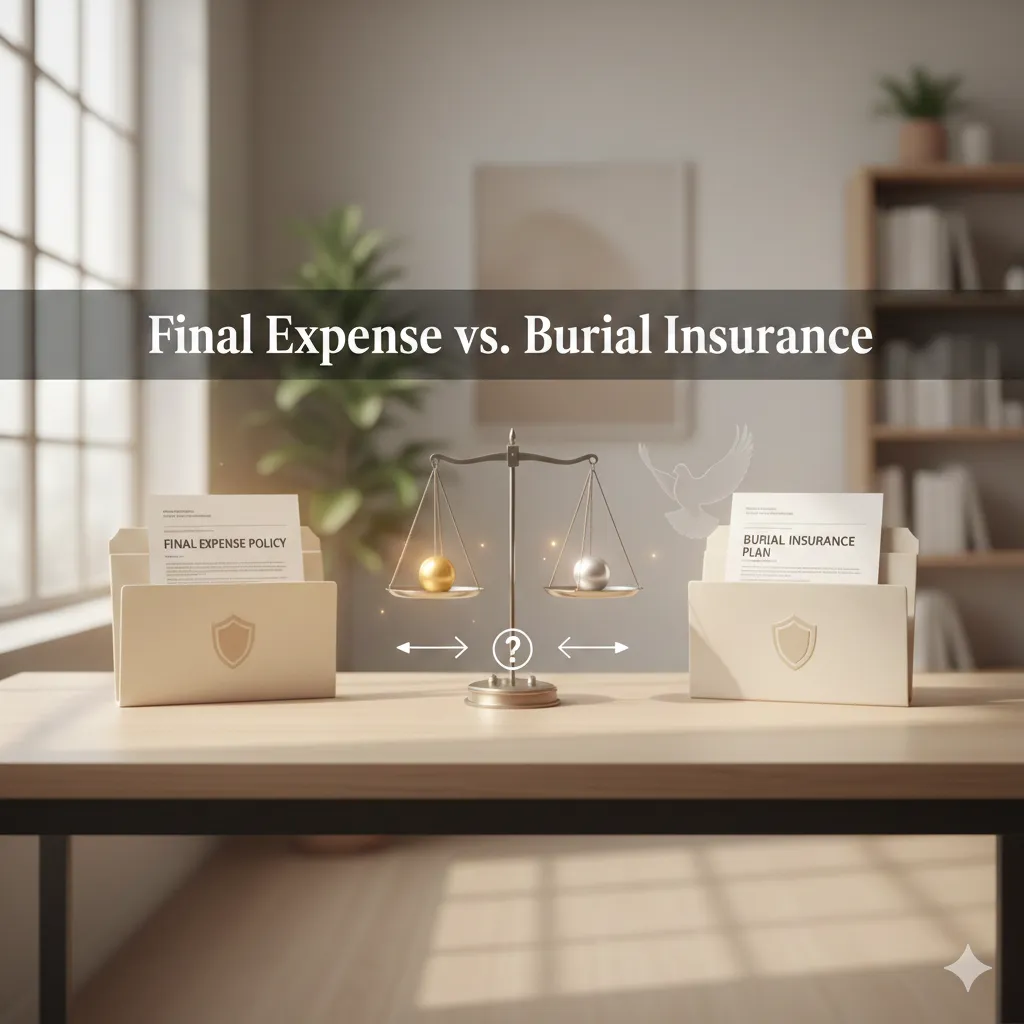
Let’s be real-if you’ve spent any time shopping for life insurance online, you’ve probably seen the terms “final expense insurance” and “burial insurance” tossed around like they’re two completely different products. Ads for one. Articles about the other. And you’re left wondering: which one do I actually need?
Here’s the short answer: they’re almost always the same thing. But “almost” is doing some important work in that sentence and the differences that do exist can affect your coverage, your cost and your family’s peace of mind.
In this guide, we’re going to clear up the confusion once and for all. By the time you’re done reading, you’ll know exactly what you’re buying, why the names differ and how to pick the right policy for your situation.
| Quick Answer Final expense insurance and burial insurance are two names for the same type of policy in most cases-a small, permanent life insurance plan designed to cover end-of-life costs. The key difference is in how they’re marketed, not what they do. |
Final expense insurance is a type of whole life insurance. That means it never expires-as long as you keep paying your premium, your family gets paid when you pass away. Simple as that.
The “final expense” name comes from what the policy is meant to cover: the costs your family will face at the end of your life. Think of it as a gift you leave behind so your loved ones don’t have to scramble for money during one of the hardest moments of their lives.
Coverage amounts are small, typically between $5,000 and $50,000-because the goal isn’t to replace your income. It’s just to handle the bills that come with passing away.
Your beneficiary can use the payout for anything. But most families put it toward:
Burial insurance is-brace yourself-almost always the exact same product as final expense insurance. Same permanent coverage. Same no-medical-exam approval. Same small benefit amounts. Same fixed premiums.
So why does it have a different name? Because insurance companies and agents discovered that different phrases resonate with different people. Some seniors respond better to “burial insurance” because it’s direct and concrete. Others prefer “final expense” because it sounds less morbid. Marketers noticed and the two names stuck.
There is one version of “burial insurance” that genuinely differs: pre-need funeral insurance. This is a specialized product sold directly by funeral homes, where the payout goes straight to the funeral home rather than to your family. We’ll cover this in detail below-it’s an important distinction to understand.
| ❌ MYTH: Burial insurance and final expense insurance are different products with different coverage. ✅ TRUTH: In the open insurance market, they refer to the same type of whole life policy. The only meaningful “burial insurance” that differs is pre-need funeral insurance sold directly by funeral homes. |
Here’s a full breakdown so you can see for yourself how similar these two products really are:
| Feature | Final Expense Insurance | Burial Insurance |
| What it is | A small whole life policy for seniors | Often the same as final expense-used interchangeably |
| Coverage amount | $5,000 – $50,000 | $5,000 – $25,000 (typically) |
| Who it’s for | Ages 50–85, any health background | Same-seniors planning ahead |
| Medical exam? | No-just a few health questions | No-simplified or guaranteed issue |
| Coverage duration | Permanent-never expires | Permanent-never expires |
| Premiums change? | No-locked in for life | No-locked in for life |
| Pays out to… | Your named beneficiary (any use) | Your named beneficiary (any use) |
| Waiting period? | Often none; graded benefit if health is poor | Often none; graded benefit if health is poor |
| Cash value? | Small amount accumulates over time | Small amount accumulates over time |
| Sold by | Licensed life insurance agents | Licensed life insurance agents |
Notice something? The columns are almost identical, because in 95% of cases, they describe the same product. The difference is almost entirely in the label, not the coverage.
Here’s where things get genuinely important-and where a lot of people get caught off guard.
When you buy final expense or burial insurance through a licensed insurance agent or broker like OLPolicy, you get a life insurance policy. The death benefit goes to your named beneficiary-your spouse, your child, whoever you choose. They can use the money however they need to.
But when a funeral home sells you “burial insurance”-usually called pre-need insurance or a preneed funeral plan-the money is assigned directly to the funeral home. Not your family. The funeral home.
| OLPolicy Expert Insight Pre-need plans aren’t necessarily bad-they can be a good fit for people who want every funeral detail locked in ahead of time. But most financial advisors recommend a flexible final expense policy instead, because it puts your family in control. Call us at (866) 757-5350 and we’ll walk you through both options. |
These policies were built for a specific person in mind: a senior between the ages of 50 and 85 who wants affordable, permanent coverage without jumping through medical hoops. If that sounds like you or someone you love, read on.
One of the biggest fears people have about life insurance is that it’ll be too expensive. Here’s the reality: final expense and burial insurance policies are specifically designed to be affordable for seniors on fixed incomes.
Your monthly cost depends on four things: your age, your gender, the coverage amount you choose and your health. Here are some realistic estimates to give you a ballpark:
| Profile | Coverage Amount | Est. Monthly Premium | Policy Type |
| Female, Age 60 | $10,000 | ~$28–$42/mo | Level benefit (no wait) |
| Male, Age 65 | $15,000 | ~$55–$72/mo | Level benefit (no wait) |
| Female, Age 70 | $10,000 | ~$48–$65/mo | Level benefit (no wait) |
| Male, Age 75 | $10,000 | ~$62–$90/mo | Level benefit (no wait) |
| Male, Age 80 | $7,500 | ~$75–$105/mo | Graded benefit |
| Female, Age 85 | $5,000 | ~$55–$80/mo | Graded or guaranteed issue |
Keep in mind these are estimates. Your exact rate depends on the insurance carrier and your specific health answers. The fastest way to get your real number is to call OLPolicy at (866) 757-5350-we compare rates across multiple top-rated carriers in minutes.
Not all policies are built the same way. When you shop for coverage, you’ll typically encounter three versions-and choosing the right one matters.
This is the gold standard. You answer a short set of health questions, get approved quickly and your full benefit is available from day one. No waiting period. If you pass away two weeks after your policy starts, your family gets the full amount.
Level benefit policies are available to applicants who can answer “no” to serious health conditions like terminal illness, active cancer, or recent heart attacks. Many people who think they won’t qualify actually do-it’s worth checking.
If you have some health conditions but still want coverage, a graded benefit policy is a solid option. These policies have a two-year waiting period for natural causes of death. If you pass away within the first two years, your family receives a refund of the premiums you paid plus interest-not the full benefit. After two years, the full payout kicks in.
Accidental death is typically covered in full from day one, even on graded policies.
No health questions. No medical exam. No rejections. Guaranteed issue policies accept applicants regardless of health history, making them the last resort for those who truly can’t qualify for anything else.
The trade-off: premiums are higher, benefit amounts are lower (usually capped around $25,000) and a two-year graded benefit period applies. But it’s real coverage-and for many seniors, it’s the only option available.
| Real Talk from Our Specialists Before you assume you need a guaranteed issue policy, let us check. Many people with diabetes, COPD, or past heart issues still qualify for level benefit policies with certain carriers. Assuming the worst often means overpaying. Call (866) 757-5350 and find out where you actually stand. |
| ❌ MYTH: You have to be in perfect health to qualify. ✅ TRUTH: Most applicants-including those with diabetes, COPD, high blood pressure and past surgeries-qualify for at least one type of policy. Guaranteed issue plans accept everyone. |
| ❌ MYTH: These policies are too expensive for seniors on fixed incomes. ✅ TRUTH: Many final expense policies start under $30/month for smaller coverage amounts. The premiums are specifically designed to be manageable for retirees and Social Security recipients. |
| ❌ MYTH: Social Security’s death benefit will cover my funeral costs. ✅ TRUTH: The Social Security one-time death benefit is only $255-a fraction of what a funeral costs today. Final expense insurance exists precisely because this benefit falls so short. |
Dorothy’s husband passed two years ago and she’s been handling everything on her own since. She doesn’t want to leave her daughter scrambling for money when the time comes. She has high blood pressure and Type 2 diabetes-both well-managed.
What she got: A level benefit final expense policy for $15,000 at $78/month. No medical exam. Approved in two days. Her daughter is the beneficiary and can use the money however she needs.
Harold had a stroke three years ago and was told by two insurance companies that he didn’t qualify for coverage. He assumed he was out of options.
What he got: A guaranteed issue burial insurance policy for $10,000 at $89/month. Yes, there’s a two-year waiting period for natural causes-but Harold feels better knowing his wife won’t face an empty bank account when he’s gone.
Linda is healthy, active and just turned 61. She has no major health conditions and wants to lock in a low rate now before she gets older and premiums go up.
What she got: A $20,000 level benefit policy at $54/month-locked in for life. Because she applied young (for this type of insurance), she’s paying some of the lowest rates available.
Yes, in the open insurance market, they are the same product-a small permanent life insurance policy for seniors. The only real difference is the name used by each insurer or agent.
Most policies range from $25 to $110 per month, depending on your age, gender, coverage amount and health. The best way to find your exact rate is to get a free quote from a licensed agent.
Yes-many carriers offer level benefit coverage to applicants with common conditions like diabetes and high blood pressure. If you don’t qualify for standard coverage, graded benefit or guaranteed issue policies are always available.
Level benefit policies typically have no waiting period at all-your coverage is active from day one. Graded benefit and guaranteed issue policies usually include a two-year waiting period for natural causes of death.
If you stop paying, your policy will lapse and coverage will end. Some policies have a small cash value that can keep the policy active for a short time-but it’s always best to speak with your agent before missing a payment.
Yes-you can name any person or organization as your beneficiary, including a spouse, child, sibling, or close friend. You can also update your beneficiary at any time.
Most carriers accept applicants up to age 85. Some guaranteed issue plans go up to age 80. If you’re older, call OLPolicy at (866) 757-5350-we know which carriers have the widest age acceptance.
Here’s the truth: the best policy is the one that’s actually in force when your family needs it. Researching is smart-but at some point, you have to make the call.
At OLPolicy, we’ve helped thousands of seniors across the country find affordable burial and final expense coverage-even those who were previously declined, have serious health conditions, or are on tight budgets.
We compare rates from the top-rated carriers so you don’t have to. And we explain everything in plain English because life insurance jargon shouldn’t be a barrier to protecting your family.
| Still Not Sure Which Policy Fits You Best? Our licensed specialists at OLPolicy will explain your options in plain English-no confusing terms, no pressure. 📞 Call OLPolicy Now: (866) 757-5350 |
No high-pressure sales tactics. No confusing insurance speak. Just honest answers and the right coverage for your life.
OLPolicy | Licensed Insurance Agency | (866) 757-5350 | www.olpolicy.com
This article is for educational purposes only. Coverage, rates and eligibility vary by carrier and state. Speak with a licensed agent for personalized advice.