
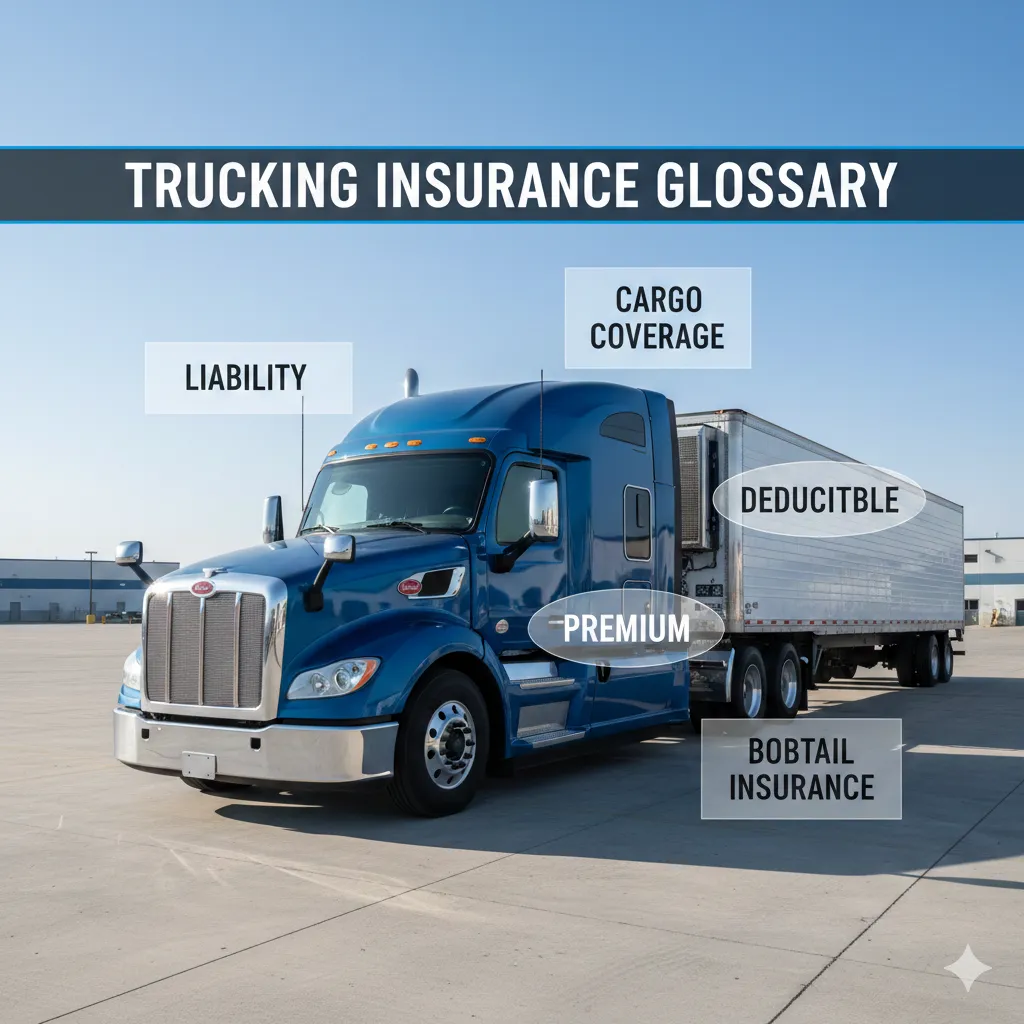
A complete A-to-Z reference of trucking insurance terms, coverage types, regulatory language andindustry concepts – explained
OLPolicy | (866) 757-5350 | Last Updated: 2026 | Over 120 terms defined
Ever signed a trucking insurance policy and realized you didn’t fully understand half the terms on the page? You’re not alone. Commercial coverage documents, FMCSA regulations, and carrier agreements are packed with technical language that can overwhelm even experienced operators. One misunderstood definition can lead to coverage gaps, compliance violations or unnecessary premium costs.
That’s exactly why this Trucking Insurance Glossary exists. It breaks down complex industry terminology into clear. Whether you’re comparing quotes, reviewing renewals or addressing compliance questions, this Trucking Insurance Glossary helps you make informed decisions with confidence.
| How to Use This Glossary
• Terms are organized alphabetically within lettered sections for easy navigation. • Bold term names are followed by a colon and plain-English definition. • “Also known as” notes identify common alternative names for the same concept. • “See also” notes point to related terms that provide additional context. • Key coverage types are followed by brief practical notes on how they apply to owner-operators and carriers. • A Quick-Reference Coverage Comparison table appears at the end for fast lookup. |
A
Actual Cash Value (ACV): The current market value of a vehicle or piece of property at the time of a loss, accounting for depreciation from its original purchase price. Physical damage claims are often settled at ACV rather than replacement cost, meaning older trucks may receive less than what it costs to replace them with a comparable unit.
Additional Insured: A person or entity added to an insurance policy that receives coverage benefits under that policy without being the named policyholder. Shippers and brokers commonly require carriers to add them as additional insureds on the carrier’s liability policy. This is typically accomplished through an endorsement at little or no additional cost.
Admitted Carrier: An insurance company that is licensed by the state insurance department in the state where it is doing business. Admitted carriers file their rates with state regulators and policyholders in admitted carrier policies are protected by the state’s guaranty fund in the event of insurer insolvency.
Aggregate Limit: The maximum total amount an insurer will pay for all covered claims combined during a policy period, regardless of the number of individual incidents. Contrasted with per-occurrence limits, which cap each individual claim. A policy may have a $1,000,000 per-occurrence limit and a $2,000,000 aggregate limit.
AM Best Rating: A financial strength rating assigned to insurance companies by AM Best, an independent rating agency. Ratings range from A++ (Superior) to D (Poor). For commercial trucking insurance, carriers with an AM Best rating of A- or better are generally considered financially stable. AM Best ratings are especially important when evaluating surplus lines carriers, which do not carry state guaranty fund protection.
Automobile Liability Insurance: Coverage that pays for bodily injury and property damage caused to third parties by the operation of a vehicle. In commercial trucking, this is typically called Primary Auto Liability and is the coverage mandated by the FMCSA for all for-hire carriers.
B
BASIC (Behavior Analysis and Safety Improvement Category): One of seven categories used by the FMCSA’s Compliance, Safety, Accountability (CSA) program to measure carrier safety performance. The seven BASICs are: Unsafe Driving, Hours of Service Compliance, Driver Fitness, Controlled Substances/Alcohol, Vehicle Maintenance, Hazardous Materials Compliance andCrash Indicator. Higher BASIC percentile scores indicate worse performance relative to comparable carriers.
Bill of Lading (BOL): A legal document issued by a carrier to a shipper that serves as a receipt for cargo, a contract of carriage anda document of title. The bill of lading defines the freight being transported, the origin and destination andthe terms of the shipping agreement. In cargo insurance, the BOL establishes when the carrier’s responsibility for the freight begins.
Binder: A temporary written agreement that provides insurance coverage while the formal policy is being prepared. A binder is typically issued at the time of policy purchase and is legally binding until the formal policy documents are issued. In commercial trucking, a binder is often needed immediately to satisfy FMCSA filing requirements or shipper certificate requests.
BMC-91 / BMC-91X: Federal insurance filing forms used to certify that a for-hire motor carrier carries the minimum primary liability insurance required by the FMCSA. The BMC-91 is filed directly by the insurer with the FMCSA electronically. A carrier’s operating authority cannot be activated or maintained without a current BMC-91 on file. The BMC-91X is an endorsement version used for certain policy structures.
BMC-34: A federal insurance filing form certifying that a motor carrier maintains cargo insurance meeting FMCSA requirements. Required only for household goods movers operating in interstate commerce; not required for general freight carriers.
BMC-35: A federal form filed by an insurer to notify the FMCSA that a carrier’s insurance policy has been cancelled or is being cancelled. Receipt of a BMC-35 filing triggers the FMCSA’s process of suspending the carrier’s operating authority if replacement coverage is not obtained before the cancellation effective date.
BOC-3: A federal form designating process agents in all states where a motor carrier operates. Required alongside the BMC-91 insurance filing as a condition of activating FMCSA operating authority. Process agents are authorized to accept legal documents on behalf of the carrier in each state.
Bobtail Insurance: Liability coverage for a truck tractor when it is operating without a trailer attached, regardless of whether the driver is under an active dispatch assignment. Bobtail insurance fills the coverage gap that exists for leased owner-operators when the carrier’s primary liability policy does not apply. Covers liability only, not physical damage to the tractor.
Bodily Injury Liability: The component of auto liability insurance that pays for medical expenses, lost wages, pain and suffering andother damages suffered by third parties who are physically injured as a result of an accident caused by the insured. One of the two main components of primary auto liability coverage, alongside property damage liability.
Broker (Freight): A company or individual that arranges transportation of freight between shippers and carriers without taking possession of the freight. Freight brokers must be licensed by the FMCSA and are required to maintain a surety bond or trust fund. Brokers are not insurers; they typically require carriers to provide certificates of insurance demonstrating required coverages.
Broker (Insurance): A licensed professional who represents the insurance buyer rather than the insurer. Insurance brokers shop multiple carriers to find coverage that meets the client’s needs and budget. In commercial trucking, working with a specialty trucking insurance broker provides access to markets not available through general agents.
C
Cargo Insurance: Coverage that protects the freight being transported against loss, damage, or theft while in the carrier’s care, custody andcontrol. See: Motor Truck Cargo Insurance.
Certificate of Insurance (COI): A document issued by an insurer or broker that summarizes the key terms of an insurance policy – coverage types, limits, effective dates andnamed insured. Certificates of insurance are provided to shippers, brokers andother parties to demonstrate that required coverage is in place. A COI is not the policy itself and does not modify coverage terms.
Claim: A formal request made to an insurer for payment of a covered loss under the terms of an insurance policy. In commercial trucking, claims can arise from liability incidents involving third parties, physical damage to the insured’s vehicle, cargo losses, or other covered events.
Collision Coverage: The component of physical damage insurance that pays to repair or replace the insured vehicle when it is damaged in a collision with another vehicle or object, regardless of fault. One of two sub-coverages within physical damage insurance, alongside comprehensive coverage.
Combined Single Limit (CSL): A single liability coverage limit that applies to both bodily injury and property damage claims arising from a single incident, rather than separate sub-limits for each. For example, a $1,000,000 CSL policy can pay up to $1,000,000 total for any combination of bodily injury and property damage from one accident.
Commercial Auto Insurance: A broad category of insurance covering vehicles used for business purposes. Commercial trucking insurance is a specialized subset of commercial auto insurance designed specifically for large commercial vehicles involved in the transportation of goods.
Commercial Driver’s License (CDL): A license required to operate commercial motor vehicles above specified weight thresholds in the United States. Class A CDL covers combination vehicles over 26,001 lbs GVWR with a towed unit over 10,000 lbs. Class B covers single vehicles over 26,001 lbs. Class C covers vehicles transporting hazardous materials or 16 or more passengers. CDL class and endorsements are primary underwriting variables in commercial trucking insurance.
Commercial General Liability (CGL): Insurance covering a business against third-party bodily injury and property damage claims arising from business operations that are not related to the operation of a vehicle. For trucking operators, CGL covers incidents at loading docks, shipper facilities andother locations where business activities create third-party exposure. Not required by the FMCSA but increasingly required by shippers and contract operations.
Comprehensive Coverage: The component of physical damage insurance that pays for damage to the insured vehicle from non-collision perils including theft, fire, vandalism, weather events (hail, flood, wind) andfalling objects. One of two sub-coverages within physical damage insurance, alongside collision coverage.
Contingent Cargo Insurance: Coverage that protects a freight broker against cargo claims when the carrier’s cargo policy fails to respond – for example, because the carrier’s policy has lapsed or contains an exclusion that applies to the loss. Required by the FMCSA for licensed freight brokers as a form of financial responsibility protection for shippers.
Continuous Coverage: Uninterrupted insurance coverage with no gaps between policy periods. The FMCSA requires continuous insurance filings for all for-hire carriers. A lapse in coverage triggers the filing of a BMC-35 cancellation notice and automatic suspension proceedings for the carrier’s operating authority.
CSA Score: A carrier’s safety performance measurement under the FMCSA’s Compliance, Safety, Accountability program, calculated using the Safety Measurement System. CSA scores are expressed as percentile rankings within each of the seven BASIC categories. Higher percentile scores indicate worse performance. CSA scores are publicly visible and are reviewed by insurance underwriters as a standard part of account evaluation.
D
DataQs: The FMCSA’s online system that allows carriers and drivers to challenge the accuracy of data recorded in the Safety Measurement System. DataQs challenges can correct errors such as incorrect violation codes, violations attributed to the wrong carrier andinaccurately coded crash records. DataQs is a data accuracy tool, not an appeals process for accurately recorded violations.
Declarations Page (Dec Page): The summary page of an insurance policy that lists the key terms: named insured, policy number, coverage types, coverage limits, deductibles, premium andeffective dates. The declarations page is the first document to review when evaluating or comparing policies.
Deductible: The amount the insured is responsible for paying out of pocket before the insurer pays the remainder of a covered claim. Higher deductibles reduce insurance premiums because the insured absorbs more of the risk. In commercial trucking, deductibles on physical damage coverage commonly range from $1,000 to $5,000 or more.
Driver Qualification File (DQF): A mandatory file that motor carriers are required to maintain for each driver, containing the driver’s application, CDL, MVR, medical certificate, road test results andannual review documentation. The contents of a driver’s DQF are relevant to underwriting because they document the carrier’s process for verifying driver qualifications.
Dual Authority: A situation in which an owner-operator holds their own motor carrier authority (their own MC number) while simultaneously operating under another carrier’s authority through a lease agreement. Dual authority creates complex insurance obligations and should be carefully reviewed with an insurance broker to avoid coverage gaps.
E
Earned Premium: The portion of a premium that an insurer has “earned” by providing coverage for the time period that has already elapsed. If a policy is cancelled mid-term, the earned premium is the amount the insurer keeps; the unearned premium is refunded to the policyholder.
Electronic Logging Device (ELD): A device connected to a vehicle’s engine that automatically records driving time and Hours of Service data. Required by federal law for most commercial drivers under the FMCSA’s ELD Mandate. ELD compliance eliminates many of the most common HOS BASIC violations. Some insurers offer premium discounts for verified ELD programs.
Endorsement: A written modification to an insurance policy that adds, removes, or changes coverage terms. Endorsements can expand coverage (adding additional insured status, adding a new vehicle) or restrict it (excluding specific cargo types or geographic areas). The BMC-91X is an example of an insurance policy endorsement for FMCSA compliance.
Endorsement (CDL): A notation on a Commercial Driver’s License authorizing the driver to operate specific vehicle types or transport specific cargo categories. Common CDL endorsements include H (Hazardous Materials), T (Double/Triple Trailers), N (Tank Vehicles), P (Passengers) andS (School Bus). Each endorsement affects the driver’s insurance profile and the carrier’s required coverage levels.
Excess Liability Insurance: Coverage that provides additional liability limits above those of an underlying primary liability policy. Excess liability responds after the primary policy’s limits are exhausted. Often used by larger carriers or those operating in high-risk environments to achieve total liability limits of $5,000,000 or more without the cost of a primary policy at that limit.
Exclusion: A provision in an insurance policy that specifically eliminates coverage for certain events, property types, locations, or circumstances. Common trucking policy exclusions include intentional acts, nuclear hazards, war andsometimes specific cargo types (e.g., live animals, tobacco, or high-value electronics). Understanding your policy’s exclusions is as important as understanding its coverages.
| Have Questions About a Term in Your Policy?
OLPolicy’s specialists can walk you through your policy language in plain English, explain how specific terms affect your coverage andhelp you identify any gaps. Understanding your coverage is the first step to protecting your operation. Call OLPolicy: (866) 757-5350 | Visit: OLPolicy.com |
F
Federal Motor Carrier Safety Administration (FMCSA): The federal agency within the U.S. Department of Transportation responsible for regulating and overseeing commercial motor vehicle safety. The FMCSA issues and manages motor carrier operating authority, sets minimum insurance requirements, administers the CSA safety program, enforces Hours of Service regulations andconducts compliance reviews of motor carriers.
Financial Responsibility: The FMCSA’s term for the insurance requirements that motor carriers must meet as a condition of operating authority. Financial responsibility encompasses the minimum levels of primary liability coverage specified in 49 CFR Part 387. Meeting financial responsibility requirements requires a current BMC-91 filing with the FMCSA, not simply holding an insurance policy.
Fleet Policy: An insurance policy that covers multiple vehicles under a single policy rather than individual policies for each unit. Fleet policies are typically more cost-effective per vehicle than individual policies for carriers with three or more trucks andthey simplify administration by consolidating coverage under one policy number and renewal date.
For-Hire Carrier: A motor carrier that transports goods or passengers for compensation. For-hire carriers are subject to FMCSA operating authority requirements and minimum insurance requirements under 49 CFR Part 387. Contrasted with private carriers, which transport only their own goods.
Force-Placed Insurance: Insurance obtained by a lender on behalf of a borrower when the borrower fails to maintain required coverage on financed property. In trucking, a lender may obtain force-placed physical damage coverage on a financed truck if the operator’s policy lapses. Force-placed insurance is typically more expensive than market-rate coverage and provides only the lender’s interests, not the operator’s.
Freight Broker Bond: A surety bond required by the FMCSA for all licensed freight brokers and freight forwarders. Currently set at $75,000, the bond protects shippers and carriers against financial harm caused by a broker’s failure to pay. The bond is distinct from insurance – it is a financial guarantee rather than a risk transfer mechanism.
G
Gap Coverage: Coverage that pays the difference between a vehicle’s actual cash value (what the insurer pays in the event of a total loss) and the outstanding loan balance on the vehicle. Without gap coverage, an operator whose truck is totaled may receive an insurance payment less than what is owed to the lender, leaving a personal financial obligation. Particularly relevant for operators with newer, heavily financed equipment.
Grace Period: A period after a premium due date during which coverage remains in force despite non-payment. Commercial trucking policies may or may not include a grace period andthe FMCSA does not recognize grace periods for insurance filing purposes. If a policy lapses, the BMC-35 cancellation filing process begins regardless of any grace period in the policy contract.
Gross Vehicle Weight Rating (GVWR): The maximum operating weight of a vehicle as specified by the manufacturer, including the vehicle, fuel, passengers andcargo. GVWR is a key classification variable in commercial trucking insurance – FMCSA insurance minimums differ based on whether a vehicle is above or below 10,001 lbs GVWR.
H
Hazardous Materials (Hazmat) Insurance: Commercial trucking insurance written specifically for carriers transporting hazardous materials as defined under federal regulations. Hazmat operations trigger elevated FMCSA insurance minimums ($1,000,000 to $5,000,000 in primary liability depending on material class) and require placement in specialty insurance markets with underwriting expertise in hazmat risks.
Hours of Service (HOS): Federal regulations governing how many hours a commercial driver may drive and must rest within specified time periods. HOS rules are enforced through ELD data and roadside inspections. Violations of HOS regulations feed into the HOS Compliance BASIC of a carrier’s CSA score and are among the most heavily weighted violations by insurance underwriters.
I
In-Transit Coverage: Insurance that protects cargo while it is being transported, from the point of origin to the point of destination. In-transit coverage is the core function of motor truck cargo insurance and is activated when the driver signs the bill of lading at pickup.
Insurance Agent: A licensed professional who sells insurance products on behalf of one or more insurance companies. Captive agents represent a single insurer; independent agents represent multiple insurers. In commercial trucking, a specialist independent agent or broker with deep trucking market access typically provides more competitive options than a general-purpose agent.
Insurance Score: A credit-based scoring model used by many insurers to predict the likelihood that a policyholder will file a claim. Based on personal and/or business credit data, insurance scores are used as a rating factor in most states for commercial trucking policies. A higher insurance score (better credit) generally correlates with lower premiums.
See also: Credit-Based Insurance Scoring
L
Lapse in Coverage: A period during which an insurance policy is not in force, creating a gap in coverage. For carriers with FMCSA operating authority, a coverage lapse triggers a BMC-35 cancellation filing and automatic authority suspension proceedings. Even a brief lapse can result in the inability to haul freight legally and negatively affects future insurance rates and market access.
Leased Owner-Operator: An owner-operator who operates their own truck under a motor carrier’s authority pursuant to a written lease agreement, rather than under their own independent authority. The carrier’s primary liability policy covers the leased owner-operator while under dispatch. The owner-operator typically remains responsible for physical damage, bobtail/non-trucking liability andoccupational accident coverage.
Liability Insurance: Insurance that pays for harm caused to third parties – other people’s bodily injury or property damage – as a result of the insured’s actions or negligence. Distinguished from first-party coverages (like physical damage) that protect the insured’s own property.
Loss Ratio: The ratio of claims paid to premiums collected, expressed as a percentage. A loss ratio of 60 percent means an insurer paid $60 in claims for every $100 in premiums collected. Underwriters track individual account loss ratios over time; accounts with consistently high loss ratios are more likely to face premium increases or non-renewal.
Loss Run: A formal document produced by an insurer that lists all claims filed under a specific policy during a defined period, including claim dates, descriptions, amounts paid andreserve amounts for open claims. Loss runs covering 3 to 5 years are required by most insurers when applying for new coverage or at renewal. They are one of the most important underwriting documents for any commercial trucking account.
M
Medical Payments Coverage (MedPay): Coverage that pays medical expenses for the driver and passengers of the insured vehicle in the event of an accident, regardless of fault. Not commonly included in standard commercial trucking policies but may be available as an endorsement.
Motor Carrier: A person or company engaged in the transportation of goods or passengers by motor vehicle for compensation. Motor carriers operating in interstate commerce are required to register with the FMCSA, obtain a USDOT number andif operating for hire, obtain an MC number and meet minimum financial responsibility requirements.
Motor Truck Cargo Insurance: Insurance covering the freight a carrier transports against loss, damage, or theft while in the carrier’s care, custody andcontrol. Coverage is triggered when the carrier accepts the freight at origin (evidenced by the bill of lading) and ends upon delivery and receipt at destination. Not required by the FMCSA for general freight carriers, but required by virtually all freight brokers as a condition of tendering loads. Standard policy limits range from $100,000 to $250,000 per occurrence for general freight.
Motor Vehicle Record (MVR): An official driving history report issued by a state DMV that lists all violations, accidents andlicense actions on a driver’s record. MVRs are one of the primary underwriting inputs for commercial trucking insurance. Most underwriters review 3 to 5 years of MVR history for all drivers on a policy. A clean MVR is one of the most powerful factors in qualifying for lower rates.
MC Number: A unique identifier assigned by the FMCSA to for-hire motor carriers upon grant of operating authority. The MC number is required on all vehicles operating under that authority and is used to identify the carrier in FMCSA databases, insurance filings androadside inspections.
N
Named Insured: The person or business entity specifically identified on the declarations page of an insurance policy as the policyholder. The named insured has the broadest rights under the policy, including the right to cancel the policy, receive premium refunds andmake coverage decisions. Distinguished from additional insureds, who have more limited rights.
Non-Admitted Carrier: An insurance company that is not licensed in the state where the insured risk is located but is permitted to write coverage through licensed surplus lines brokers. Non-admitted carriers are not subject to state rate regulation and policyholders are not protected by the state guaranty fund. Also called surplus lines carriers.
Non-Owned Trailer Coverage: Physical damage coverage for trailers that are not owned by the insured but are in the insured’s possession. Relevant for owner-operators who pull trailers belonging to carriers or shippers under trailer interchange agreements. Without non-owned trailer coverage or trailer interchange coverage, physical damage to a non-owned trailer while in the driver’s possession may not be covered.
Non-Trucking Liability Insurance (NTL): Liability coverage for a commercial truck during personal, non-business use – specifically when the driver is not under active dispatch and the vehicle is not being used for any purpose related to the trucking business. Distinct from bobtail insurance, which covers the vehicle any time it is operating without a trailer, including for business repositioning purposes. NTL is typically required by carrier lease agreements for leased owner-operators.
O
Occupational Accident Insurance: A private insurance product providing income replacement, medical expense coverage anddeath benefits for owner-operators and independent contractors who are injured or killed in work-related accidents. Occupational accident insurance is the primary alternative to workers’ compensation for self-employed truckers who are not eligible for state workers’ compensation programs. Coverage, limits andexclusions vary significantly between policies.
Operating Authority: The legal authorization granted by the FMCSA to a motor carrier to engage in for-hire transportation in interstate commerce. Operating authority is evidenced by an active MC number in the FMCSA database and requires current insurance filings (BMC-91), a process agent designation (BOC-3) andregistration with the Unified Registration System. Operating authority can be suspended or revoked for insurance lapses, safety violations, or failure to maintain required filings.
Out-of-Service (OOS) Order: A formal directive issued by FMCSA enforcement personnel or roadside inspectors requiring a driver, vehicle, or carrier to cease operations until identified safety violations are corrected. Out-of-service orders are recorded in the CSA system and contribute to a carrier’s BASIC scores. An active out-of-service order on a carrier’s record is a serious underwriting flag and may result in policy non-renewal or cancellation.
Owner-Operator: An independent commercial truck driver who owns or leases their own truck and may operate either under their own motor carrier authority or leased to an established carrier. Owner-operators bear personal responsibility for a significant portion of their insurance obligations, which vary depending on their operating structure.
P
Per-Occurrence Limit: The maximum amount an insurer will pay for all claims arising from a single incident or occurrence. Contrasted with the aggregate limit, which caps total payments across all incidents in a policy period. FMCSA minimum liability requirements are expressed as per-occurrence limits.
Physical Damage Insurance: Coverage that pays to repair or replace the insured’s own vehicle after a covered loss. Physical damage insurance combines collision coverage (accident damage) and comprehensive coverage (theft, fire, weather andother non-collision perils). Not required by the FMCSA but typically required by lenders for financed vehicles.
Policy: The complete written contract between the insured and the insurer, including the declarations page, coverage forms, endorsements andexclusions. The policy document governs all rights and obligations of both parties. The declarations page summarizes key terms; the coverage forms and exclusions define the details of what is and is not covered.
Policy Limit: The maximum amount an insurer will pay under a specific coverage within a policy. Policy limits can be expressed as per-occurrence limits (maximum per single incident) and/or aggregate limits (maximum across all incidents in the policy period).
Policy Period: The duration of time during which an insurance policy is in force. Commercial trucking policies typically have a one-year policy period, though shorter-term policies may be available for specific situations. Coverage applies only to incidents that occur during the policy period.
Premium: The amount paid by the insured to the insurer for coverage during the policy period. Premiums are calculated based on the underwriter’s assessment of the risk presented by the insured’s operation, including factors such as vehicle type, cargo, operating radius, driver history andclaims history.
Primary Auto Liability Insurance: The foundational insurance coverage for commercial motor carriers, covering bodily injury and property damage caused to third parties by the insured’s vehicle. Primary liability is the coverage mandated by the FMCSA for all for-hire carriers, with minimum limits ranging from $300,000 to $5,000,000 depending on the operation type. It is typically the most expensive component of a trucking insurance package.
Private Carrier: A business that transports only its own goods using its own vehicles, rather than transporting goods for others for compensation. Private carriers are not required to obtain for-hire operating authority from the FMCSA but are subject to FMCSA safety regulations and minimum insurance requirements for vehicles over 10,001 lbs operating in interstate commerce.
Property Damage Liability: The component of auto liability insurance that pays for damage caused to third parties’ property – other vehicles, structures andpersonal property – as a result of an accident caused by the insured. One of the two main components of primary auto liability coverage, alongside bodily injury liability.
| Not Sure If You Have the Right Coverage?
OLPolicy reviews your entire coverage package to identify gaps, duplications andopportunities to optimize your protection and cost. Get a free coverage review from our commercial transportation specialists. Call OLPolicy: (866) 757-5350 | Visit: OLPolicy.com |
R
Rated Driver: A driver whose information is included in the insurance policy and whose driving history is considered in the underwriting and pricing of the policy. All drivers who regularly operate insured vehicles should be listed as rated drivers. Failing to list a driver can result in a coverage denial for accidents that occur when an unlisted driver is operating the vehicle.
Refrigeration Breakdown Coverage: An endorsement to motor truck cargo insurance that covers spoilage of perishable cargo caused by the failure of the refrigeration unit. Standard cargo policies typically exclude mechanical breakdown of the reefer unit; this endorsement fills that gap for carriers transporting refrigerated freight.
Reinstatement: The restoration of a cancelled or lapsed insurance policy. In commercial trucking, reinstatement after a coverage lapse requires obtaining a new policy, having the insurer file a new BMC-91 with the FMCSA andwaiting for FMCSA confirmation before legally resuming for-hire operations.
Replacement Cost Value (RCV): The cost to replace a damaged or destroyed vehicle with a comparable new unit at current market prices, without deducting for depreciation. Contrasted with actual cash value (ACV), which accounts for depreciation. Most physical damage policies settle on an ACV basis unless specifically written with a replacement cost endorsement.
Reserve: The amount set aside by an insurer to cover future payments on an open claim that has been reported but not yet fully settled. Reserves appear on loss runs as “open reserve” amounts and represent the insurer’s estimate of what will ultimately be paid on the claim. High open reserves on a loss run can affect underwriting decisions even before a claim is fully closed.
S
Safety Management System (SMS): The FMCSA’s data system that calculates carrier CSA scores by aggregating roadside inspection, crash andinvestigation data into BASIC percentile rankings. The SMS is updated monthly and is publicly accessible at ai.fmcsa.dot.gov. Insurance underwriters review SMS data as a standard part of commercial trucking account evaluation.
Self-Insured Retention (SIR): Similar to a deductible but with an important distinction: under a SIR, the insured pays all costs – including defense costs – up to the SIR amount before the insurer’s coverage begins. Under a traditional deductible structure, the insurer typically handles defense from the first dollar and then seeks reimbursement from the insured for the deductible amount. SIRs are more common in large fleet programs.
Split Limits: A liability coverage structure that specifies separate maximum amounts for bodily injury per person, bodily injury per accident andproperty damage per accident. For example, a 1,000,000/2,000,000/250,000 split limit policy pays up to $1,000,000 per injured person, $2,000,000 total for all bodily injury in one accident and$250,000 for property damage. Contrasted with combined single limit (CSL) policies.
Stated Value: A method of valuing a vehicle in a physical damage policy where the insured and insurer agree on a specific dollar value for the vehicle at policy inception. In the event of a total loss, payment is limited to the lesser of the stated value or the actual cash value at the time of loss. Stated value policies provide more predictability than ACV-only policies but do not guarantee full replacement cost.
Subrogation: The legal right of an insurer to pursue a third party that caused an insurance loss, after the insurer has compensated the insured for that loss. For example, if a carrier is hit by a negligent driver and the carrier’s physical damage insurer pays for the truck repairs, the insurer may then pursue the negligent driver’s insurer for reimbursement. Subrogation rights are standard in most insurance policies.
Surety Bond: A three-party financial guarantee in which a surety company (the bond issuer) guarantees to a third party (the obligee) that the principal (the bonded party) will fulfill specified obligations. In trucking, freight brokers are required to maintain a $75,000 surety bond with the FMCSA. Surety bonds are not insurance – they are a guarantee backed by the principal’s obligation to repay the surety.
Surplus Lines Insurance: Insurance placed with non-admitted carriers through licensed surplus lines brokers for risks that admitted carriers decline or cannot accommodate. Surplus lines carriers have more underwriting flexibility but are not subject to state rate regulation andpolicyholders do not have state guaranty fund protection. Common placement for new authorities, hazmat operations andcarriers with adverse loss history or elevated CSA scores.
T
Trailer Interchange Insurance: Physical damage coverage for non-owned trailers in the insured’s possession under a written trailer interchange agreement. Covers damage to the trailer while it is being used by the insured, regardless of fault. Required by many carrier and shipper contracts for operations involving a trailer pool or drop-and-hook freight.
U
Umbrella Insurance: A liability policy providing coverage above the limits of underlying primary liability and other base policies. In commercial trucking, an umbrella policy might provide an additional $5,000,000 in coverage above a $1,000,000 primary liability policy, for a total of $6,000,000 in liability protection. Umbrella policies are often the most cost-effective way to achieve high total liability limits.
Underwriting: The process by which an insurer evaluates the risk presented by a potential insured and determines whether to offer coverage and at what premium. In commercial trucking, underwriting involves reviewing the carrier’s USDOT number, MVRs, loss runs, CSA scores, fleet details, cargo type andoperating profile. The underwriting outcome determines both market access and premium level.
Unearned Premium: The portion of a premium that applies to the future, unexpired portion of a policy period. If a policy is cancelled, the unearned premium is typically refunded to the policyholder on a pro-rata basis (full proportional refund) or short-rate basis (proportional refund with a penalty for early cancellation).
Unified Registration System (URS): The FMCSA’s online portal for registering motor carriers, freight brokers, freight forwarders andother regulated entities. The URS is the system through which new operating authority applications are submitted and through which carriers manage their registration information.
USDOT Number: A unique identification number issued by the FMCSA to all commercial motor vehicle operators engaged in interstate commerce, including both for-hire carriers and private carriers meeting weight or cargo thresholds. The USDOT number is displayed on the vehicle and is used to track safety and compliance data in FMCSA databases. Distinct from the MC number, which applies only to for-hire carriers.
W
Workers’ Compensation Insurance: A state-mandated insurance program that provides medical and income replacement benefits to employees who are injured or become ill as a result of their work. Owner-operators are generally classified as self-employed independent contractors and are typically not eligible for workers’ compensation. Occupational accident insurance is the common alternative for owner-operators.
Waiver of Subrogation: An endorsement to an insurance policy in which the insurer agrees to waive its right to pursue a third party for reimbursement of a paid claim. Shippers and contract partners often require carriers to add a waiver of subrogation in their favor on the carrier’s liability and cargo policies. This prevents the carrier’s insurer from seeking recovery from the shipper if a loss is partly attributable to the shipper’s negligence.
Use this table for a fast comparison of the most common commercial trucking coverage types – what each covers, whether it is required andwho typically needs it.
| Coverage Type | What It Covers | FMCSA Required? | Market Required? | Who Needs It |
| Primary Auto Liability | Bodily injury & property damage to third parties | Yes | Yes ($1M standard) | All for-hire carriers |
| Physical Damage | Your own truck (collision + comprehensive) | No | If financed: Yes | All operators with financed trucks; strongly advised for all |
| Motor Truck Cargo | Freight you haul against loss/damage/theft | No* | Yes (brokers) | All carriers hauling for others |
| Bobtail Insurance | Liability when operating without trailer (any time) | No | Often (lease) | Leased owner-operators |
| Non-Trucking Liability | Liability during personal non-business use only | No | Often (lease) | Leased owner-operators |
| Occupational Accident | Driver injury, disability, death benefits | No | No | All owner-operators (no workers’ comp eligibility) |
| General Liability | Third-party injury/damage not involving your vehicle | No | Shippers/contracts | Carriers with dedicated or contract operations |
| Trailer Interchange | Physical damage to non-owned trailers in your possession | No | Contract-dependent | Drop-and-hook, trailer pool operations |
| Excess / Umbrella | Additional liability above primary policy limits | No | Sometimes | Larger carriers, high-value cargo, high-risk routes |
| Contingent Cargo | Cargo claims when carrier’s policy fails to respond | No | FMCSA (brokers) | Licensed freight brokers |
* Cargo insurance (BMC-34 filing) is required by the FMCSA only for household goods movers. For all other carriers, it is a freight market requirement rather than a federal one.
Several pairs of trucking insurance terms are frequently confused with each other. This section clarifies the distinctions that matter most in practice.
| Bobtail vs. Non-Trucking Liability
Bobtail insurance covers your tractor any time it is operating without a trailer attached – including business repositioning trips and driving to a fuel stop between dispatches. Non-trucking liability covers only genuinely personal use, with no connection to your business operations. If you are driving your truck for any business-related purpose, bobtail is the relevant coverage, not NTL. Many leased owner-operators need both. |
| Actual Cash Value vs. Stated Value vs. Replacement Cost
ACV pays what your truck was worth at the time of loss, after depreciation. Stated Value is an agreed amount at policy inception – but payment is still limited to the lesser of stated value or ACV at loss time, so it does not guarantee full stated value payment. Replacement Cost pays what it actually costs to replace the truck with a comparable new unit, without depreciation. Most physical damage policies default to ACV; always confirm which basis your policy uses. |
| Per-Occurrence Limit vs. Aggregate Limit
The per-occurrence limit is the maximum paid for any single incident. The aggregate limit is the total maximum paid across all incidents in a policy year. A policy with a $1,000,000 per-occurrence limit and a $2,000,000 aggregate can pay up to $1,000,000 per accident, but will stop paying additional claims once total payments reach $2,000,000 for the year – regardless of how many accidents occurred. |
| Insurance Broker vs. Insurance Agent
An insurance agent represents the insurance company and sells that company’s products. A captive agent represents only one company; an independent agent may represent several. An insurance broker represents the buyer, not the insurer – their legal obligation is to find the best coverage for the client’s needs across multiple markets. In commercial trucking, a specialist broker typically provides broader market access and more objective advice than a captive agent. |
| Deductible vs. Self-Insured Retention (SIR)
Both represent the insured’s out-of-pocket responsibility before the insurer pays. The key difference is in how defense costs are handled. With a deductible, the insurer typically defends the claim from the first dollar and then bills the insured for the deductible amount. With a SIR, the insured pays all costs – including attorneys’ fees and defense costs – up to the SIR amount before the insurer becomes involved. SIRs are more common in large fleet or self-insured programs. |
Understanding the language in your policy is the foundation of knowing whether your operation is truly protected. If a term in your policy or in a quote you have received is unclear, OLPolicy’s commercial transportation specialists will explain it in plain English and help you evaluate whether your current coverage matches your actual risk.
Whether you need help understanding a specific term, reviewing a new policy, or shopping your coverage at renewal, OLPolicy is ready to help.
| Talk to a Trucking Insurance Specialist at OLPolicy
Plain English answers to your coverage questions. Competitive quotes from multiple top-rated carriers. BMC-91 filings handled for you. OLPolicy is your partner in commercial transportation insurance. Call OLPolicy: (866) 757-5350 | Visit: OLPolicy.com |
Disclaimer: This glossary is provided for general informational and educational purposes only and does not constitute legal, regulatory, or insurance advice. Insurance terms, coverage definitions andregulatory requirements vary by carrier, state andpolicy and are subject to change. Always review the specific language of your policy and consult a licensed commercial insurance professional for advice specific to your operation. OLPolicy is a licensed insurance agency.