Are you confused about commercial property vs general liability insurance and not sure which one your business actually needs? You are not alone. Thousands of U.S. business owners struggle with this exact question every year. One policy protects your physical assets like your building, equipment and inventory. The other protects you when someone sues your business for injury or damages. Choosing the wrong one or skipping one entirely can cost you everything. Commercial property insurance coverage guards what you own. General liability insurance coverage guards what you owe others. Together, they build a complete shield around your business. This guide breaks down every difference so you can choose with total confidence.
Commercial property insurance is a policy that protects your business’s physical assets. Think of it as a financial safety net for everything you can touch and see inside and around your business. If a covered event damages or destroys your property, this policy steps in and pays to repair or replace it. Without it, you absorb every loss out of pocket.
This type of property insurance for businesses covers far more than just your building. It extends to your equipment, your inventory, your furniture and in many cases, the income you lose when you cannot operate. According to the Insurance Information Institute, property damage is among the top five most common causes of business losses in the United States. Every business that owns or leases a physical space needs this protection.
So, what does commercial property insurance cover exactly? At its core, it covers direct physical loss or damage to your business property caused by specific events. These events called “covered perils” typically include fire damage, theft, vandalism, water damage and natural disasters like hailstorms or windstorms.
There are two main coverage structures you need to understand. A named perils policy only covers the specific risks listed in your policy document. An open perils policy also called “all-risk” covers everything except what is explicitly excluded. Open perils policies offer broader protection but come with higher insurance premiums. For most U.S. businesses, an open perils policy provides the strongest business property protection insurance available.
| Coverage Structure | What It Covers | Best For |
| Named Perils Policy | Only listed risks (fire, theft, etc.) | Budget-conscious small businesses |
| Open Perils / All-Risk | Everything except listed exclusions | Businesses with high-value assets |
| Replacement Cost Coverage | Full replacement value, no depreciation | Newer businesses with new equipment |
| Actual Cash Value Coverage | Replacement cost minus depreciation | Older businesses with aging assets |
Commercial property insurance coverage applies to a surprisingly wide range of assets. Most business owners think only about their building. But your policy can protect much more than four walls and a roof.
Real property refers to the physical building itself walls, roof, floors, attached fixtures and any permanently installed systems like plumbing or electrical. Business personal property (BPP) covers movable items inside the building equipment and inventory, computers, office furniture and supplies and tools. If you lease your space and made improvements or renovations, those upgrades called betterments are also typically covered. Outdoor property like signs, fences and landscaping may be covered up to a sub-limit. Always check your policy exclusions to understand what does not qualify.
Real businesses face real threats every single day. Fire damage is the most financially devastating the National Fire Protection Association (NFPA) reports that U.S. fire departments respond to an estimated 100,000 non-residential structure fires each year. Theft and vandalism are also alarmingly common. The FBI’s Uniform Crime Report consistently shows billions of dollars in annual property losses from burglary and larceny targeting commercial properties.
Storm damage including wind, hail and lightning ranks among the top causes of property damage claims filed by U.S. businesses each year. Water damage from burst pipes, roof leaks, or appliance failures rounds out the most frequent claims. Note that standard commercial property insurance policies typically exclude flood damage. For flood risk, you need a separate policy through the National Flood Insurance Program (NFIP) or a private flood insurer.
General liability insurance is the cornerstone of business risk protection insurance. While commercial property protects your stuff, general liability protects your business when someone else gets hurt or claims you caused them harm. It covers legal costs, medical bills and settlements that arise from third-party claims against your business. In short, it is your legal and financial armor.
The Small Business Administration (SBA) strongly recommends general liability insurance for virtually every type of business. Why? Because lawsuits are expensive. Even a frivolous claim can cost tens of thousands of dollars in legal defense costs alone before a single judgment is rendered. Legal liability coverage for businesses is not optional. It is survival.
What does general liability insurance cover? It covers three primary areas of risk. First, bodily injury claims when someone physically gets hurt at your business location or because of your operations. Second, property damage claims when your business accidentally damages someone else’s property. Third, personal and advertising injury when your marketing or communications cause harm to another party’s reputation or violate their rights.
Beyond those core areas, general liability insurance coverage also pays for legal expenses coverage including attorney fees, court costs and any settlements and judgments that result from covered claims. This is third-party liability coverage, meaning the claim comes from outside your business. Your policy steps in on your behalf so you are not personally bankrupted by a lawsuit.
Third-party claims are the beating heart of general liability coverage. Imagine a customer walks into your coffee shop, slips on a freshly mopped floor and breaks their wrist. That is a slip and fall accident one of the most common customer injury claims in the United States. Your general liability insurance pays the customer’s medical bills and covers your legal defense if they sue.
Property damage works the same way. Say you run a landscaping company and your crew accidentally drives a mower through a client’s fence. Your general liability insurance covers the repair costs. Without this coverage, you pay those costs directly. A single incident like this can wipe out weeks or months of profit for a small business. Third-party liability coverage prevents exactly that kind of financial gut punch.
Here is a fact that shocks many business owners. You do not have to lose a lawsuit to lose money. Legal defense costs attorney fees, expert witness fees, court filing fees can easily reach $50,000 to $150,000 for a moderately complex civil case. And if the court rules against you, settlements and judgments can push that number into the millions.
General liability insurance covers your legal defense costs from dollar one, regardless of whether the claim has merit. It pays for your attorney. It pays court costs. And if a settlement is reached or a judgment is entered against you, it pays that too up to your coverage limits. This is why liability insurance for small business is considered a non-negotiable baseline for any operation that interacts with the public, clients, or other businesses.
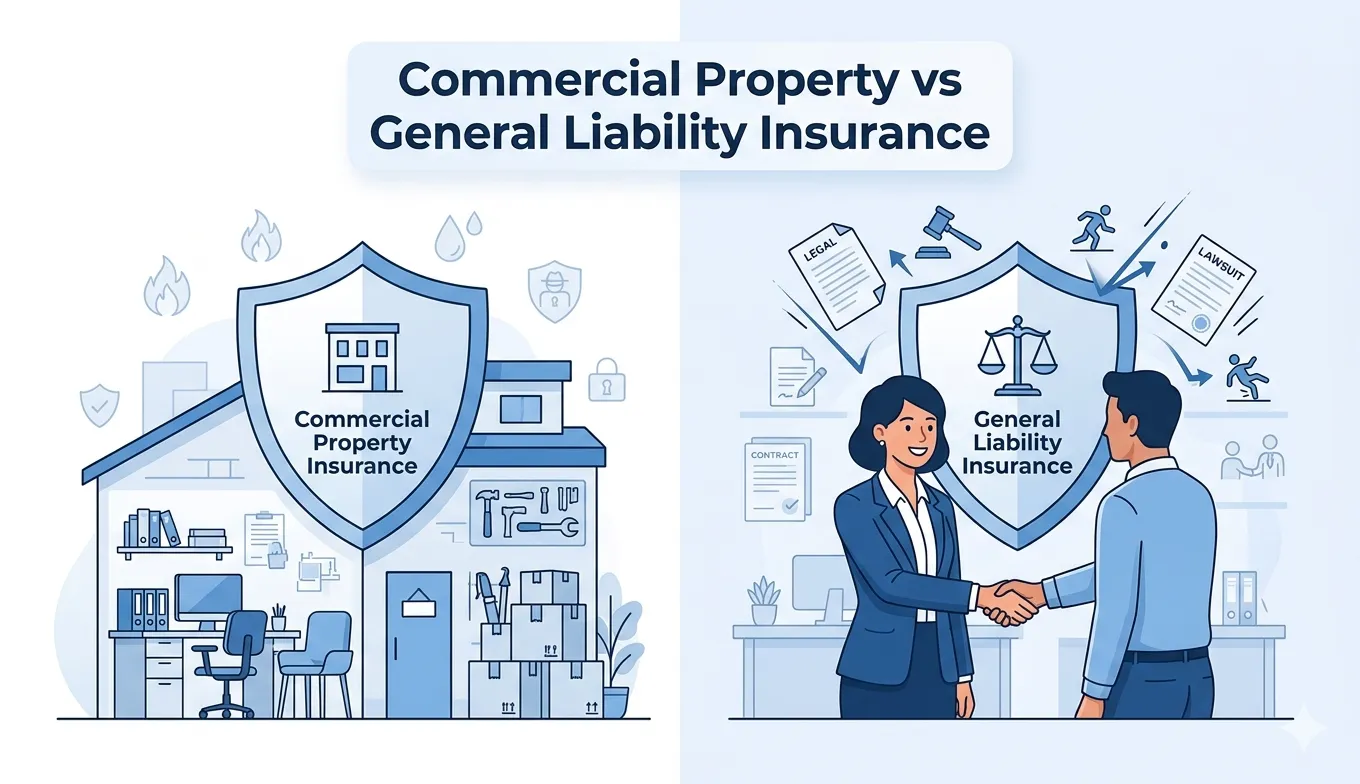
Here is where most business owners get confused. Commercial property vs general liability insurance what actually separates them? The simplest answer: one policy protects your assets and the other protects your liability. But the difference between property and liability insurance runs much deeper than that simple summary. Understanding both is the foundation of a smart business insurance coverage comparison.
Commercial property insurance is reactive to physical damage. Something breaks, burns, gets stolen, or gets damaged and the policy pays. General liability insurance is reactive to legal claims. Someone sues you or files a claim against your business and the policy pays. Both are essential. Neither replaces the other. Think of them as two legs of the same table. Remove one and your entire financial protection collapses.
Property protection and legal liability coverage operate in completely different arenas. Commercial property insurance your physical asset protection insurance keeps your business running after a physical loss. It replaces your stolen laptop. It rebuilds your damaged storefront. It compensates for lost insured business assets. The claim flows from you to your insurer.
Legal liability coverage for businesses flips that dynamic entirely. Here, someone outside your business a customer, a vendor, a passerby files a claim against you. You did not initiate this process. They did. Your general liability insurance steps in, defends you and pays valid claims on your behalf. These two policies live in entirely separate risk universes. You genuinely need both.
This distinction is fundamental to understanding commercial insurance coverage types. Commercial property insurance is first-party coverage. You are the first party. You own the assets. You file the claim when your property suffers a covered loss. The insurer pays you directly to repair or replace your damaged property.
General liability insurance is third-party coverage. A third party someone outside your business brings a claim against you. You did not ask for the claim. You did not file it. It was filed against you. Your general liability insurance responds to that external claim and protects your business from the financial fallout. This first-party vs third-party distinction explains why the difference between liability insurance and property insurance is so much more than just what gets covered it is about who initiates the protection.
| Feature | Commercial Property Insurance | General Liability Insurance |
| Coverage Type | First-party | Third-party |
| Who Files the Claim | You (the business owner) | A third party (customer, vendor, visitor) |
| What It Protects | Your physical business assets | Your legal responsibility to others |
| Trigger Event | Physical damage or loss | Injury, property damage, or advertising harm to others |
| Example Scenario | Fire destroys your inventory | Customer sues after a slip-and-fall |
| Pays For | Repair/replacement of property | Legal fees, settlements, medical bills |
Walk through these real-world scenarios and you will instantly see how each policy applies in practice.
Scenario 1: A burst pipe floods your restaurant kitchen overnight. Equipment is ruined. Commercial property insurance covers the equipment replacement and structural repairs.
Scenario 2: A vendor visiting your office trips over an exposed cable and breaks their collarbone. They sue you for bodily injury claims and medical expenses. General liability insurance responds.
Scenario 3: A thief breaks into your boutique and steals $15,000 in inventory. Commercial property insurance covers the theft loss. General liability insurance does not apply.
Scenario 4: Your employee accidentally knocks over a client’s expensive vase while delivering a package. The client demands compensation for property damage. General liability insurance covers this claim.
These scenarios illustrate the clean, clear dividing line in commercial insurance policies between protecting your own property and protecting others from harm caused by your business.
Commercial property insurance coverage is broader than most business owners realize when they first buy a policy. Beyond the basics of fire and theft, a well-structured policy covers multiple layers of your business’s financial foundation. It is designed to ensure that one bad event does not permanently shut down your operation. This is small business property insurance working exactly as intended.
The core of the policy focuses on business buildings and premises, equipment, tools and inventory and critically business interruption coverage. Each of these components plays a distinct role in keeping your business financially solvent after a covered loss. Let’s unpack each one so you know exactly what you are and are not paying for.
If you own your building, commercial property insurance covers the structure itself against covered perils including fire damage, storm damage, vandalism and more. This includes the walls, roof, foundation, permanently installed fixtures and mechanical systems. If a windstorm tears off your roof, your policy pays for the repair.
If you lease your space, your coverage still matters. You are typically responsible for covering office furniture and supplies, your equipment and any improvements you made to the space. Your landlord carries coverage on the actual building structure but that policy does not protect your personal business assets inside. Always clarify with your landlord and your insurer exactly where one policy ends and the other begins. Getting this wrong leaves you with a dangerous gap in your business property protection insurance.
Equipment and inventory represent the operational lifeblood of most businesses. A contractor’s tools. A photographer’s camera gear. A retailer’s merchandise. A restaurant’s kitchen equipment. All of these fall under the business personal property umbrella of your commercial property insurance policy.
Coverage typically pays the replacement cost or actual cash value of damaged or stolen items, depending on your policy terms. Replacement cost coverage pays what it costs to buy a brand-new equivalent item today. Actual cash value pays replacement cost minus depreciation. For high-value equipment and inventory, replacement cost coverage is almost always worth the slightly higher insurance premium. A restaurant owner who loses $40,000 in kitchen equipment to a grease fire will feel the difference between those two coverage types immediately.
Business interruption coverage is one of the most underappreciated components of commercial property insurance. It kicks in when a covered event forces you to temporarily close or significantly reduce operations. While your property insurance repairs the physical damage, business interruption coverage replaces the income you are losing while repairs happen.
This coverage typically pays for lost net income, ongoing fixed expenses like rent and payroll and sometimes the cost of operating from a temporary location. During the period following Hurricane Harvey in 2017, countless Texas businesses discovered just how critical and sometimes absent this coverage was. According to Insureon, the average business interruption claim lasts approximately 10 months. That is 10 months of rent, payroll and overhead with no revenue coming in. Business interruption coverage is not a luxury. It is a lifeline.
General liability insurance coverage wraps around your business like a legal force field. It responds any time your business operations, products, or premises cause harm to someone outside your organization. Whether it is a slip and fall accident, accidental property damage, or a negligence claim arising from your work this policy is designed to absorb the financial blow.
The three primary pillars of general liability insurance are bodily injury claims, property damage to third parties and advertising or personal injury. Understanding all three helps you see the full scope of protection this commercial insurance for business owners provides and why no business that interacts with the outside world should go without it.
Bodily injury claims arise when someone suffers a physical injury because of your business. The most classic example is a slip and fall accident a customer slips on a wet floor, a delivery driver trips over a misplaced pallet, or a child gets hurt on your premises. These incidents happen every day across the United States.
Your general liability insurance covers the injured party’s medical expenses, your legal defense costs if they sue and any resulting settlements and judgments. It even covers claims that turn out to be frivolous because you still need legal representation even when you did nothing wrong. The coverage limits on your policy determine the maximum payout. Most small businesses start with a $1 million per-occurrence limit and a $2 million aggregate limit standard benchmarks in liability insurance for small business policies across the U.S.
Property damage claims under general liability insurance cover situations where your business or someone working for your business accidentally damages another person’s or company’s property. This is separate from the property damage covered under your own commercial property policy. That covers your stuff. This covers damage you cause to others.
A plumber who accidentally cracks a client’s tile floor. A web designer who corrupts a client’s server data during a project. A moving company that drops and breaks expensive furniture. All of these situations trigger general liability insurance under the property damage claims provision. Without this coverage, your business is personally responsible for every dollar of that damage. Third-party liability coverage ensures those unexpected costs do not derail your entire business financially.
Advertising injury claims are less talked about but increasingly important in the digital age. This coverage protects your business if your marketing, advertising, or communications cause harm to another party. Covered claims include libel (written defamation), slander (spoken defamation), copyright infringement and wrongful use of another party’s advertising idea.
For example, imagine your social media team posts a comparison ad that a competitor claims defames their brand. They file a lawsuit alleging advertising injury. Your general liability insurance covers your legal defense and any resulting settlement. Similarly, if a blog post on your website accidentally reproduces copyrighted material and the rights holder sues, this provision responds. In an era where businesses market aggressively online, advertising injury claims coverage is a quietly essential piece of your legal liability coverage for businesses.
Business liability insurance extends well beyond general liability. As your business grows, so does your exposure to specialized risks that a standard general liability insurance policy simply was not designed to cover. Commercial insurance coverage types have evolved to address these gaps and knowing which ones apply to your business can mean the difference between full protection and catastrophic exposure.
Think of the standard general liability insurance policy as your foundation. On top of that foundation, you can layer specialized commercial insurance policies that cover the unique risks of your industry, your workforce and your digital footprint. Here are the most important ones every U.S. business owner should know.
Professional liability insurance also called errors and omissions insurance (E&O) covers negligence claims arising from the professional services you provide. If a client alleges that your advice, recommendations, or work caused them financial harm, your standard general liability insurance will not cover it. You need professional liability insurance.
Accountants, attorneys, consultants, marketing agencies, architects and IT professionals are among the most common buyers of errors and omissions insurance (E&O). A consultant who gives a client flawed financial advice that leads to a $200,000 loss faces a negligence claim that could easily exceed that amount once legal defense costs are factored in. Professional liability insurance covers those costs and protects the consultant’s business from ruin.
Product liability insurance protects businesses that manufacture, distribute, or sell physical products. If a product you sell causes injury or property damage to a consumer, product liability insurance responds to the resulting bodily injury claims or property damage claims.
A small candle maker whose product starts a house fire. A food manufacturer whose product causes illness. A toy company whose product injures a child. All face potentially enormous lawsuits against businesses for product-related harm. The Consumer Product Safety Commission (CPSC) reports that product-related injuries cost the U.S. economy over $1 trillion annually. Product liability insurance is non-negotiable for any business in the product supply chain.
Cyber liability insurance addresses one of the fastest-growing threats in modern business digital attacks and data breaches. Standard commercial property insurance and general liability insurance policies do not cover losses from cyberattacks. You need a dedicated cyber liability insurance policy for that.
This coverage pays for the costs of a data breach notifying affected customers, credit monitoring services, data recovery, regulatory fines and legal defense costs from resulting lawsuits against businesses. According to IBM’s Cost of a Data Breach Report, the average cost of a data breach in the United States reached $9.48 million in 2023 the highest of any country in the world. For any business that stores customer data, processes payments, or operates online, cyber liability insurance is no longer optional.
Employment practices liability insurance (EPLI) covers lawsuits against businesses brought by employees or former employees. These claims include wrongful termination, workplace discrimination, sexual harassment, retaliation and failure to promote. They are shockingly common. The EEOC receives over 70,000 workplace discrimination charges annually.
Your standard general liability insurance does not cover employment-related claims. EPLI fills that gap directly. It pays your legal defense costs, any settlements and judgments and covers the administrative burden of responding to EEOC investigations. For any business with employees even just one or two EPLI is a critical piece of complete small business insurance protection.
The short answer is yes emphatically. The longer answer explains why the question itself reveals a dangerous misconception. Many small business owners assume they only need one type of coverage. They either focus on protecting their assets and skip liability, or they carry liability and assume their property can absorb losses. Both approaches leave gaping holes in their business insurance coverage comparison.
Property vs liability insurance for small business is not an either/or decision. It is a both/and necessity. A coffee shop owner needs their espresso machines covered if they are destroyed by fire and they need general liability insurance if a customer burns themselves on a faulty cup lid. A graphic designer working from a home studio needs business property protection insurance for their equipment and professional liability insurance if a client claims their design work cost them business. The risks are different. The policies are different. And both are real.
Small businesses in the United States face an extraordinary range of risks every single day. According to a 2023 survey by the Insurance Journal, over 40% of small businesses will file at least one insurance claim within a 10-year period. The most common claims involve property damage, bodily injury claims, theft and vandalism and water damage.
Slip and fall accidents alone cost U.S. businesses an estimated $70 billion annually in workers’ compensation and liability costs, according to the National Floor Safety Institute. Fire damage claims average over $35,000 per incident for small businesses. Theft from business premises costs the retail industry alone over $60 billion per year. These are not abstract possibilities. They are statistical certainties that small business insurance protection is specifically designed to absorb.
Carrying both commercial property insurance and general liability insurance does more than just double your coverage it eliminates dangerous gaps that neither policy can fill alone. Think of it this way: your property policy protects you from losses you suffer. Your liability policy protects you from losses you cause others. Without both, you are only protected in one direction.
Consider a bakery owner. A grease fire destroys their oven and display cases commercial property insurance handles the physical repair and replacement. The same fire spreads smoke damage to a neighboring shop general liability insurance covers the neighbor’s property damage claims against you. One event. Two completely separate coverage needs. Two policies working in tandem. That is business insurance coverage comparison in real life and it demonstrates exactly why combining coverage is the smartest move any small business owner can make.
The business owner’s policy (BOP) is the most practical and cost-efficient insurance solution available to small and mid-size businesses in the United States. It bundles commercial property insurance and general liability insurance into a single, streamlined policy at a lower combined premium than purchasing each separately. It is the insurance industry’s answer to the small business owner who needs comprehensive commercial insurance for business owners without the complexity of managing multiple separate policies.
A business owner’s policy is not just a discount package. It is a purpose-built solution designed by insurers specifically for businesses with annual revenues typically below $5–$10 million, depending on the insurer. Most major carriers including The Hartford, Nationwide, Travelers and Hiscox offer BOP insurance tailored to specific industries. This bundled business insurance approach simplifies your coverage, reduces administrative overhead and ensures both critical coverage types are always in force together.
A standard business owner’s policy (BOP) combines three core elements into one policy. First, commercial property insurance protecting your business buildings and premises, equipment and inventory and office furniture and supplies. Second, general liability insurance covering bodily injury claims, property damage claims and advertising injury claims. Third, business interruption coverage replacing lost income when a covered event forces you to close temporarily.
Beyond these core components, most insurers allow you to customize your BOP with endorsements and add-ons tailored to your specific business. These optional additions can include cyber liability insurance, professional liability insurance, employment practices liability, commercial auto coverage and more.
| BOP Core Component | What It Covers |
| Commercial Property Insurance | Buildings, equipment, inventory, furniture |
| General Liability Insurance | Bodily injury, property damage, advertising injury |
| Business Interruption Coverage | Lost income and ongoing expenses during closure |
| Optional: Cyber Liability | Data breaches, ransomware, digital attacks |
| Optional: Professional Liability | Negligence claims from professional services |
| Optional: EPLI | Employment-related lawsuits |
Bundling business insurance through a BOP delivers tangible financial and operational benefits. The most immediate benefit is cost. Purchasing commercial property insurance and general liability insurance separately typically costs 10%–15% more than combining them in a business owner’s policy. For a small business paying $2,500 per year total, that savings adds up to hundreds of dollars annually.
Beyond cost, bundling simplifies your insurance claims process. With a single carrier managing both policies, there is no dispute between two insurers about which policy applies to a given claim. A single point of contact. A single renewal date. A single set of policy documents to manage. For a business owner already juggling a hundred responsibilities, this administrative simplicity is genuinely valuable. Bundled business insurance is smarter, leaner and more coherent than a patchwork of separate policies.
Cost is always the first question and it deserves a direct, honest answer. Commercial property insurance and general liability insurance costs vary widely based on your industry, location, business size and coverage selections. But solid national averages give you a starting benchmark for your budgeting.
According to Insureon’s 2024 small business insurance data, the median annual cost of general liability insurance for a small business is approximately $500–$1,500 per year. The median annual cost of commercial property insurance ranges from $1,000–$3,000 per year depending on the value of insured business assets and location. A business owner’s policy (BOP) combining both typically runs $1,200–$3,500 per year less than buying each separately.
| Policy Type | Typical Annual Cost (U.S. Small Business) | Key Cost Driver |
| General Liability Insurance | $500 – $1,500 | Industry, revenue, claims history |
| Commercial Property Insurance | $1,000 – $3,000 | Property value, location, building age |
| Business Owner’s Policy (BOP) | $1,200 – $3,500 | Combined property value + liability exposure |
| Professional Liability (E&O) | $900 – $2,500 | Industry, services provided, revenue |
| Cyber Liability Insurance | $1,000 – $2,500 | Data volume, security practices, industry |
Your insurance premium is not random. Insurers calculate it based on a precise set of risk factors that they have refined over decades of claims data. Understanding these factors helps you anticipate your costs and in some cases, take action to reduce them.
Industry type is the single biggest driver. A construction company faces far greater bodily injury and property damage risk than a web design agency and pays significantly higher premiums accordingly. Business location matters too. Properties in flood-prone areas, high-crime ZIP codes, or disaster-prone regions carry higher commercial property insurance rates. Claims history plays a major role a business with a history of frequent or large claims pays more than a business with a clean record. Coverage limits and deductibles directly affect your premium higher limits cost more and higher deductibles lower your premium. Finally, the age and construction type of your building affects your property rates. Older buildings with outdated electrical or plumbing systems cost more to insure.
Coverage limits are the maximum amounts your insurer will pay for a covered claim. Business insurance policy limits come in two forms. The per-occurrence limit is the maximum payout for a single claim. The aggregate limit is the maximum total payout across all claims in a policy year. For general liability insurance, a standard small business policy typically carries a $1 million per-occurrence limit and a $2 million aggregate limit.
Your deductible is the amount you pay out of pocket before your insurance kicks in. A higher deductible reduces your annual insurance premium sometimes significantly. But it also means absorbing more cost when a claim occurs. A business with strong cash reserves might choose a $2,500 or $5,000 deductible to reduce monthly costs. A newer business with limited reserves might prefer a lower deductible for maximum first-dollar protection. Balancing coverage limits and deductibles is one of the most important decisions in structuring your commercial insurance coverage types.
Choosing the right business insurance coverage is not about buying the cheapest policy it is about buying the right policy for your specific risks. The U.S. insurance market offers hundreds of options across dozens of carriers. That abundance of choice is a gift and a trap simultaneously. The goal is not to eliminate all possible risk. The goal is to transfer the risks that could financially destroy your business to an insurer who can absorb them.
A smart approach to business insurance coverage comparison starts with a clear-eyed assessment of your unique exposures. What could go wrong in your business? What would it cost if it did? Which of those costs could you absorb yourself and which ones would break you? Those answers point directly to the policies you need, the coverage limits that make sense and the insurance premiums you should be willing to pay.
Business risk assessment starts with five core questions. First: Do you own or lease physical space? If yes, commercial property insurance is essential. Second: Do customers, clients, or vendors ever visit your location? If yes, general liability insurance is non-negotiable. Third: Do you provide professional advice or services? If yes, add professional liability insurance. Fourth: Do you manufacture or sell physical products? If yes, add product liability insurance. Fifth: Do you store customer data digitally? If yes, cyber liability insurance belongs in your portfolio.
Beyond those five questions, consider your industry’s specific risk profile. Restaurants face fire damage, slip and fall accidents and food contamination risks. Contractors face bodily injury claims and property damage claims at job sites. Retailers face theft and vandalism, product liability and customer injury claims. Each industry has a distinct risk fingerprint and your commercial insurance policies should be shaped to match it precisely.
Once you know what coverage you need, the next step is finding the right provider at the right price. Start by gathering at least three quotes from different carriers. Do not compare only on price compare coverage limits, policy exclusions, deductibles and the insurer’s financial strength rating.
Financial strength ratings from agencies like AM Best tell you how capable an insurer is of paying claims when disaster strikes. Look for carriers rated A- or better. Independent insurance brokers unlike direct-to-consumer platforms shop multiple carriers on your behalf and can often find better pricing and broader coverage. Resources like Insureon, The Hartford and the National Association of Insurance Commissioners (NAIC) are excellent starting points for research. Always read the full policy document not just the summary before signing anything. The policy exclusions section is where the surprises hide.
“The best insurance policy is the one you have when you need it not the cheapest one you could find.” Common wisdom among independent insurance brokers across the U.S.
Understanding commercial property vs general liability insurance is not just an academic exercise. It is a practical, urgent and financially consequential decision that every U.S. business owner faces. These two policies protect fundamentally different things your business property on one side and your legal liability to others on the other. Neither is optional. Neither replaces the other.
The smartest move for most small and mid-size businesses is a business owner’s policy (BOP) combining both commercial property insurance and general liability insurance at a bundled rate, with the option to add specialized coverage as your business grows. Start by assessing your real risks. Compare providers carefully. Check your coverage limits against your actual exposure. And never let cost alone drive the decision because the cost of being underinsured will always exceed the cost of doing it right.
Ready to protect your business the right way? Start with a free quote from a licensed independent broker or visit SBA.gov for trusted guidance on business insurance coverage tailored to your specific business type and state.