
The Complete Guide to What the Government Pays – and What It Doesn’t
By OLPolicy | Licensed Insurance Specialists | Call (866) 757-5350
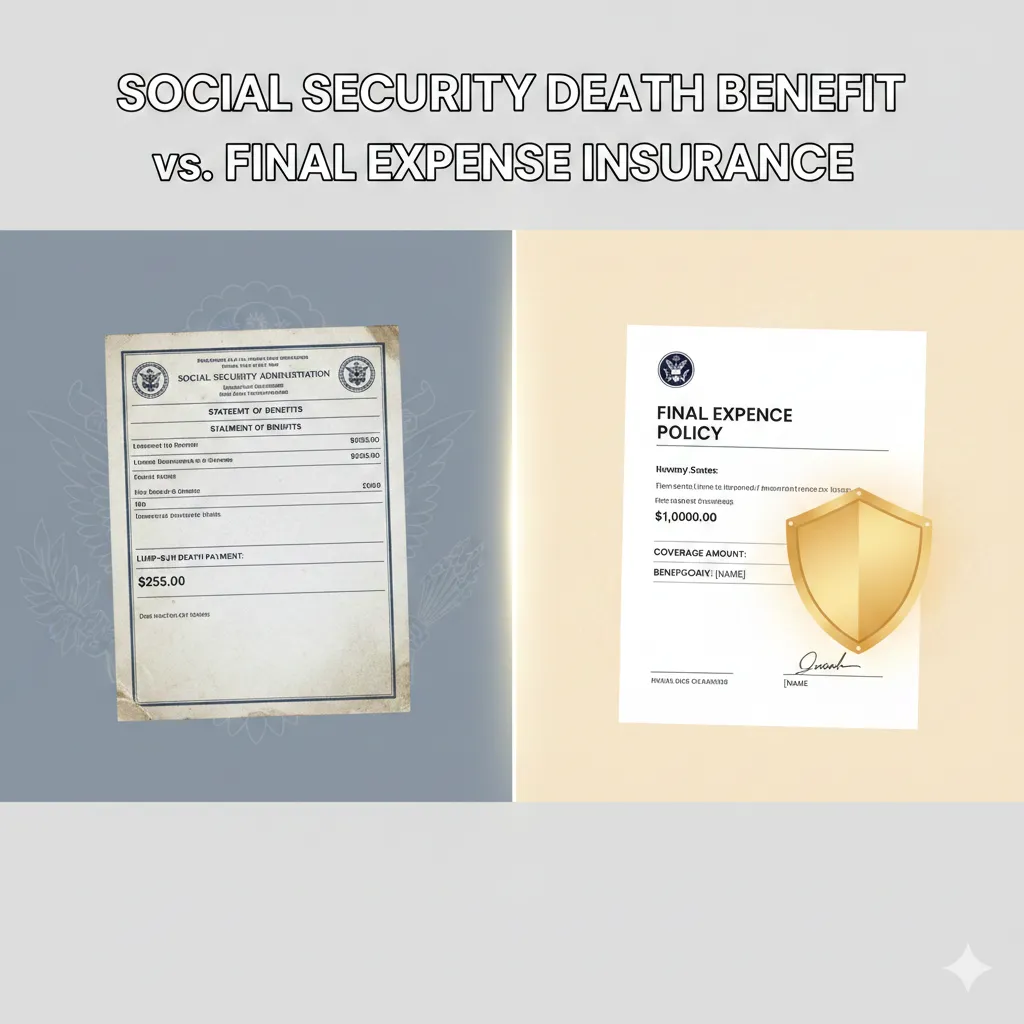
When a loved one passes away, families often assume that Social Security will help cover funeral and burial costs. It is a natural assumption – millions of Americans have paid into Social Security their entire working lives, and the system does include a death benefit. But here is the truth that most families only discover after it is too late: the Social Security lump-sum death benefit is $255.
That is not a typo. Two hundred and fifty-five dollars. The average American funeral costs between $7,000 and $12,000. That means Social Security covers roughly 2% to 3% of what most families actually need. The other 97% has to come from somewhere – and without a plan in place, it falls directly on the people left behind.
This guide from OLPolicy explains exactly what the Social Security Death Benefit vs. Final Expense Insurance, who qualifies for it, how to claim it, and – most importantly – why final expense insurance is the only reliable way to make sure your family is truly protected when the time comes. We will cover everything in plain language, with no jargon and no sales pressure.
| Quick Answer
The Social Security lump-sum death payment is a one-time $255 benefit paid to a surviving spouse or eligible child of a deceased worker. It does not cover funeral costs. The average funeral costs $7,000 to $12,000. Final expense insurance fills this gap with a guaranteed death benefit of $5,000 to $50,000, paid directly to your family within days of a claim. Call OLPolicy at (866) 757-5350 for a free, no-pressure quote. |
The Social Security Administration (SSA) offers a one-time payment called the Lump-Sum Death Payment (LSDP). It is a fixed benefit of $255, paid to a qualifying survivor of a deceased Social Security-covered worker. This program has existed since 1954, and the benefit amount has not increased since 1954 – not once in over 70 years, despite decades of inflation and rising costs.
To put that in perspective: in 1954, the average cost of a funeral was approximately $700 to $900. The $255 lump sum represented a meaningful fraction of that cost – roughly 28% to 36%. Today, with the average funeral costing $7,000 to $12,000 or more, that same $255 represents less than 4 cents on the dollar. It has not kept pace with inflation by any measure.
The Social Security death benefit was never designed to cover funeral expenses in full. It was intended as a small, symbolic contribution toward end-of-life costs in an era when funerals were far cheaper. Today, it is widely considered a token payment that families should acknowledge – but never rely on.
| Important: The $255 Must Be Applied For – It Is Not Automatic
Many families miss the Social Security death benefit entirely because they do not know they need to apply for it. The SSA does not automatically send the payment. A surviving spouse or eligible child must apply within two years of the worker’s death. Applying is free, but failing to apply means losing the benefit permanently. |
Not everyone is automatically entitled to the Social Security lump-sum death payment. The SSA has specific rules about who can receive it – and many families are surprised to discover they do not qualify at all, or that the benefit goes to someone other than who they expected.
The Social Security lump-sum death payment can only be paid to one of the following qualifying survivors, in order of priority:
| Priority | Who Qualifies | Conditions |
| 1st – Surviving Spouse | A spouse who was living with the deceased at the time of death | Must have been residing together, or receiving Social Security benefits on the worker’s record |
| 2nd – Surviving Spouse (apart) | A spouse not living with the deceased at time of death | Must have been eligible for Social Security benefits on the worker’s record in the month of death |
| 3rd – Eligible Child | A child of the deceased worker | Only if no qualifying spouse exists; child must be eligible for benefits on worker’s record in month of death |
There are many situations in which no one qualifies for the Social Security lump-sum death payment – or where the payment goes to an unexpected person. Families in the following situations typically receive nothing:
This means that for millions of Americans – particularly those who are single, widowed, divorced, in non-married partnerships, or estranged from family – the Social Security death benefit pays out nothing at all. Even for those who do qualify, the $255 barely covers the cost of printing an obituary.
If you believe a surviving spouse or eligible child qualifies for the $255 lump-sum death payment, here is how to apply. Remember: you must apply – the SSA does not automatically process this payment.
| Step | What to Do |
| 1. Do Not Delay | You have two years from the date of death to apply. Missing this window means losing the benefit permanently. Apply as soon as possible after the death. |
| 2. Call the SSA | Contact the Social Security Administration at 1-800-772-1213 (TTY: 1-800-325-0778). The SSA does not accept online applications for the lump-sum death payment – you must call or visit a local office. |
| 3. Visit a Local SSA Office | You can also apply in person at your nearest Social Security Administration office. Bring required documentation (see below). |
| 4. Gather Required Documents | You will need: the deceased’s Social Security number, a certified copy of the death certificate, the surviving spouse’s or child’s Social Security number, and proof of relationship (marriage certificate or birth certificate). |
| 5. Receive Your Payment | If approved, the $255 is typically paid by direct deposit to the surviving spouse’s or child’s bank account, or by check. Processing times vary but are usually within 30 to 60 days. |
| OLPolicy Specialist Tip
If you are the surviving family member handling arrangements, the funeral home will often help you notify the SSA of the death. However, the funeral home cannot apply for the $255 benefit on your behalf – you must do that yourself by calling the SSA directly at 1-800-772-1213. |
To understand why the $255 Social Security death benefit is so insufficient, you need to understand what a funeral actually costs. The numbers are sobering – and they have increased steadily every year.
| Service | Average Cost | Notes |
| Basic Services Fee (Funeral Home) | $2,300 – $3,500 | Non-declinable base fee for funeral director services |
| Embalming | $700 – $900 | Not legally required in most states, but standard practice |
| Casket (mid-range) | $2,000 – $5,000 | Can range from $1,000 to $10,000+ depending on material |
| Burial Vault or Grave Liner | $1,000 – $1,500 | Required by most cemeteries |
| Cemetery Plot | $1,000 – $4,000 | Urban areas significantly higher |
| Graveside Service | $500 – $800 | Includes setup, equipment, shelter |
| Hearse and Transportation | $300 – $500 | Local transportation of remains |
| Death Certificates (5 copies) | $50 – $150 | Multiple copies needed for various institutions |
| Obituary Notice | $200 – $500 | Varies widely by publication |
| Flowers and Programs | $300 – $800 | Variable based on family preferences |
| Reception / Repast | $500 – $2,500+ | Highly variable – often hosted by family |
| TOTAL (Typical Full Funeral) | $7,000 – $12,000+ | National average for traditional burial |
Many families consider cremation a more affordable alternative to traditional burial. While cremation is less expensive, the costs are still far beyond what Social Security covers:
| Cremation Service Type | Average Cost | What’s Included |
| Direct Cremation (basic) | $700 – $1,500 | Minimal service – no viewing, no ceremony, simple urn |
| Cremation with Memorial Service | $2,500 – $5,000 | Memorial ceremony, urn, death certificates |
| Cremation with Full Funeral Service | $4,000 – $7,000 | Viewing, ceremony, cremation, urn, full services |
Even the most basic direct cremation – the least expensive option available – costs $700 to $1,500. The $255 Social Security death benefit does not come close to covering even this minimum. After 70 years of zero increases, the gap between what Social Security pays and what families actually need has never been wider.
| The Real Cost of Having No Plan
When a family member passes away without final expense insurance and the only government benefit available is $255, families face a $7,000 to $12,000 bill with little or no time to prepare. Many families go into credit card debt, drain emergency savings, sell personal property, or launch GoFundMe campaigns to cover these costs. This is the financial reality that final expense insurance is designed to prevent. |
Final expense insurance – also called burial insurance or funeral insurance – is a type of permanent whole life insurance policy designed specifically to cover end-of-life costs. It provides a guaranteed death benefit of $5,000 to $50,000, paid directly to the beneficiary you name, as a tax-free cash payment, within days of filing a claim.
Unlike the Social Security death benefit, final expense insurance does not expire, does not require a waiting period after death to apply for, and does not restrict how the money is spent. Your beneficiary receives the funds and uses them however your family needs – whether that means paying the funeral home directly, settling a hospital bill, or covering household expenses while the family gets back on its feet.
Use this comparison to see exactly how these two sources of end-of-life funding differ – and why relying on Social Security alone leaves most families dangerously exposed.
| Factor | Social Security Death Benefit | Final Expense Insurance | Winner |
| Benefit Amount | $255 (fixed, never changes) | $5,000 – $50,000 (you choose) | Final Expense ✓ |
| Who Receives It | Qualifying spouse or eligible child only | Any person you name as beneficiary | Final Expense ✓ |
| Covers Funeral Costs? | Less than 4% of average funeral | Fully covers most funeral costs | Final Expense ✓ |
| Application Required After Death? | Yes – survivor must apply within 2 years | Beneficiary files a simple claim form | Final Expense ✓ |
| Automatic Payment? | No – must be applied for | Paid automatically upon claim approval | Final Expense ✓ |
| Who Qualifies? | Only married spouses or eligible children | Anyone the policyholder names | Final Expense ✓ |
| How Long to Receive Funds? | 30 to 60 days or more | 7 to 30 days in most cases | Final Expense ✓ |
| Affected by Marital Status? | Yes – single/divorced people lose the benefit | No – any beneficiary qualifies | Final Expense ✓ |
| Monthly Cost to the Insured | $0 (funded through FICA taxes during career) | $30 to $150/month depending on age | Social Security ✓ |
| Inflation Protection? | None – $255 since 1954 | Coverage amount stays fixed at purchase | Tie |
| Restrictions on Use of Funds? | Paid to estate if no qualifying survivor exists | No restrictions – cash to beneficiary | Final Expense ✓ |
| Available to Everyone? | Only to SS-covered workers with qualifying survivors | Any senior aged 50–85 in most states | Final Expense ✓ |
The comparison makes clear that Social Security’s $255 death payment and final expense insurance serve fundamentally different purposes. Social Security provides a token benefit to a narrowly defined group of survivors. Final expense insurance provides meaningful, flexible, and guaranteed financial protection to whoever you choose – on your terms.
| The Bottom Line on Social Security vs. Final Expense Insurance
Social Security’s $255 death benefit is not a burial plan. It is a 70-year-old relic that has never been adjusted for inflation and covers less than 4% of what a real funeral costs today. Final expense insurance is the only reliable way to make sure your family does not face a $10,000 bill at the worst possible moment. Call OLPolicy at (866) 757-5350 to get your free quote today. |
Beyond the $255 Social Security lump-sum payment, families sometimes ask about other government programs that might help with burial and funeral costs. Here is an honest overview:
Some state Medicaid programs offer limited financial assistance for funeral costs for individuals who were Medicaid recipients at the time of death and whose estates cannot cover burial expenses. The amounts vary dramatically by state, from as little as $250 to as much as $1,500 in some states. This assistance is means-tested, applies only to Medicaid recipients, and requires an application through the state agency. It is not available in all states and is subject to annual budget changes.
Eligible veterans may qualify for VA burial benefits, which can be significantly more meaningful than the Social Security death benefit. VA burial benefits for veterans who die of a service-connected condition may cover burial and funeral expenses and a burial plot or interment in a national cemetery. Veterans who die of non-service-connected conditions and were receiving VA pension or compensation may receive a smaller burial allowance. Families of veterans should always apply for VA burial benefits in addition to exploring final expense insurance.
Most counties and municipalities have indigent burial programs for individuals who die with no estate and no family able to cover burial costs. These programs typically provide the most basic direct cremation or burial – with no viewing, no service, and no family involvement in arrangements. This is a last resort, not a plan.
During the COVID-19 pandemic, FEMA offered a temporary funeral assistance program for deaths attributable to COVID-19. As of 2024, this program has concluded. FEMA does not offer ongoing funeral assistance for deaths from causes other than declared national disasters.
| Program | Who Qualifies | Amount | Realistic Assessment |
| Social Security LSDP | Surviving spouse or eligible child of covered worker | $255 | Token payment – covers almost nothing |
| Medicaid Funeral Assistance | Deceased was a Medicaid recipient; family cannot cover costs | $250 – $1,500 (varies by state) | Very limited; not available in all states |
| VA Burial Benefits (service-connected) | Veteran who died of service-connected condition | Up to full burial cost | Significant benefit for qualifying veterans |
| VA Burial Allowance (non-service) | Veteran receiving VA pension at death | $300 – $796 (2024 rates) | Helpful but still far short of full cost |
| County Indigent Burial | No estate, no family able to pay | Basic cremation or burial only | Last resort – no family involvement |
| Final Expense Insurance | Anyone aged 50–85 in most states | $5,000 – $50,000 | The only reliable, complete solution |
Even when you stack every available government program together – Social Security, Medicaid assistance, and VA benefits for qualifying veterans – most families still face a significant gap between what government programs provide and what a meaningful funeral actually costs. Final expense insurance is the only way to close that gap reliably and completely.
Final expense insurance is the right choice for a wide range of seniors and families. Here is a clear breakdown of who benefits most from having a policy in place:
| Scenario 1 – No Plan: The Wilson Family, Rural Mississippi
Margaret Wilson, 78, passed away after a brief illness. She had worked most of her life in service jobs and received Social Security retirement benefits of $840 per month. Her surviving adult children – three of them, all working hourly jobs – assumed Social Security would help pay for the funeral. When they called the SSA, they learned the $255 benefit could only go to a surviving spouse. Margaret had been widowed for 12 years. The payment went to no one. The funeral home quoted $9,200 for a traditional service. The family put $4,000 on credit cards, borrowed $3,000 from a relative, and spent the next eight months paying off the debt. “We were grieving and stressed about money at the same time,” Margaret’s daughter said. “She would have hated that.” |
| Scenario 2 – With a Plan: The Johnson Family, Birmingham, Alabama
Robert Johnson, 74, had purchased a $15,000 final expense policy through OLPolicy four years earlier at a cost of $97 per month. When Robert passed, his daughter – the named beneficiary – called OLPolicy’s claims line, submitted the death certificate and claim form, and received $15,000 by direct deposit within 11 days. The family held a beautiful homegoing service at their church. The funeral home was paid in full. The family had $3,200 left over, which they used to cover travel costs for out-of-town relatives and a family meal after the service. “Daddy took care of us even when he was gone,” Robert’s daughter said. “That meant everything.” |
| Scenario 3 – Partial Plan: The Rivera Family, San Antonio, Texas
Carmen Rivera, 69, had heard about the VA burial benefit for her late husband, a veteran, and assumed the $255 Social Security payment would also help when she passed. What she didn’t realize was that neither benefit would apply to her own death – she was not a veteran, and the Social Security $255 would only go to a surviving spouse, which she no longer had. After speaking with OLPolicy, Carmen purchased a $12,000 final expense policy for $78 per month. Her son is now the beneficiary, and Carmen told us: “I finally stopped worrying about this. I know it’s handled.” |
Getting covered is faster and simpler than most people expect. Here is what the process looks like when you work with OLPolicy:
| Step | What Happens |
| Call OLPolicy at (866) 757-5350 | A licensed specialist gathers your basic information: name, age, gender, state of residence, and general health history. This takes 10 to 15 minutes. |
| Review Your Options | Your specialist presents quotes from multiple top-rated carriers side by side – showing monthly premium, coverage amount, benefit type, and carrier rating for each option. |
| Choose Your Policy and Beneficiary | Select the plan that fits your budget. Name your beneficiary – the person who will receive the death benefit. You can name any person you choose. |
| Complete the Application | A short, one-to-two-page application – completed by phone or online in under 20 minutes. Health questions are answered verbally with your specialist. |
| Get Approved | Most applications are approved within 24 to 72 hours. Some carriers offer same-day approval for straightforward applications. |
| Receive Your Policy Documents | Your policy is mailed to you. Keep it in a safe place and make sure your beneficiary knows where to find it and how to file a claim. |
| No Medical Exam Required – Most Seniors Qualify
Unlike traditional life insurance, final expense insurance does not require a medical exam. Approval is based on a short health questionnaire. Most seniors – including those with diabetes, high blood pressure, heart conditions, and COPD – qualify for coverage. Call OLPolicy at (866) 757-5350 and we will find the right policy for your health profile and budget. |
Final expense insurance premiums are calculated based on your age, gender, health status, and the coverage amount you choose. Premiums are locked in at the time of purchase and never increase – even as you age or if your health changes. Here are realistic monthly premium estimates for non-tobacco applicants:
| Age at Purchase | $10,000 Benefit | $15,000 Benefit | $20,000 Benefit |
| 55 | $28 – $38 | $40 – $55 | $52 – $70 |
| 60 | $34 – $46 | $49 – $67 | $63 – $87 |
| 65 | $43 – $58 | $63 – $85 | $82 – $112 |
| 70 | $58 – $78 | $85 – $115 | $110 – $150 |
| 75 | $78 – $105 | $114 – $155 | $148 – $202 |
| 80 | $105 – $142 | $154 – $210 | $201 – $276 |
| Age at Purchase | $10,000 Benefit | $15,000 Benefit | $20,000 Benefit |
| 55 | $34 – $46 | $50 – $67 | $65 – $87 |
| 60 | $43 – $58 | $63 – $85 | $82 – $111 |
| 65 | $57 – $77 | $84 – $114 | $110 – $149 |
| 70 | $77 – $104 | $113 – $154 | $148 – $202 |
| 75 | $104 – $141 | $153 – $208 | $200 – $273 |
| 80 | $138 – $188 | $204 – $278 | $268 – $366 |
For context: a 68-year-old woman can purchase a $15,000 final expense policy for approximately $95 to $125 per month. At that rate, she would need to live for approximately seven to ten years for the premiums paid to equal the death benefit – and the coverage begins on day one. For most seniors, the math strongly favors purchasing coverage sooner rather than later.
| Lock Your Rate In Now – Every Year Costs More
Final expense insurance premiums increase with every year of age at the time of purchase. A 65-year-old locking in a $15,000 policy today pays significantly less per month than a 72-year-old purchasing the same coverage. If you are considering final expense insurance, the best time to purchase is now. Call OLPolicy at (866) 757-5350 to get your rate before it increases. |
Q: Does everyone who worked and paid Social Security taxes qualify for the $255 death benefit?
A: No. The $255 lump-sum death payment is only available to a surviving spouse who lived with the deceased or was receiving benefits on the worker’s record, or to an eligible child receiving benefits. If you were single, divorced, or have no eligible survivors, no one receives the $255. Paying into Social Security your entire life does not guarantee your family will receive any death benefit.
Q: Can the Social Security $255 death benefit be used to help pay for a funeral?
A: Technically yes – the survivor who receives it can use it however they choose. But at $255, it represents less than 4% of the average funeral cost. It is more useful as a symbolic acknowledgment than as meaningful financial assistance. Final expense insurance is the only reliable way to actually cover funeral costs.
Q: If I already receive Social Security retirement benefits, does my family automatically get more when I die?
A: Receiving Social Security retirement benefits does not increase the $255 lump-sum death payment or guarantee that a survivor will receive it. The survivor must meet separate eligibility rules and must apply within two years of the death. Your monthly retirement benefits stop at death – they do not continue to your family unless a qualifying spouse is eligible for survivor benefits.
Q: Can I use final expense insurance to pre-plan my funeral with a specific funeral home?
A: Final expense insurance pays a cash benefit to your named beneficiary – it does not lock you into a specific funeral home. Your family can use the funds at any funeral home they choose. This flexibility is one of the advantages final expense insurance has over pre-need funeral plans, which are tied to a specific funeral home that may change ownership or close.
Q: I am 77 years old and have never had life insurance. Is it too late to get final expense coverage?
A: It is not too late. Most final expense insurance carriers accept applicants up to age 85, and some up to age 89. Even at 77, you can get a meaningful policy with a fixed premium that covers your family’s funeral costs. The premium will be higher than it would have been at a younger age, but the coverage and the protection it provides for your family are the same. Call OLPolicy at (866) 757-5350 for a free, no-pressure quote.
The Social Security lump-sum death payment is a well-intentioned but deeply inadequate benefit. At $255 – a number frozen in place since 1954 – it covers almost nothing in a world where a dignified funeral costs $7,000 to $12,000. And for millions of Americans who are single, divorced, or whose survivors simply do not meet the SSA’s narrow eligibility rules, it pays out nothing at all.
Final expense insurance was created specifically to fill this gap. It is affordable. It is accessible. It requires no medical exam. And it gives your family the one thing that the Social Security Administration cannot: a guarantee that when the time comes, the people you love will not have to choose between honoring your memory and paying their bills.
You worked hard your entire life. You deserve to leave your family protected – not burdened. One phone call to OLPolicy can change that.
| Ready to Protect Your Family? Call OLPolicy Today.
Our licensed insurance specialists are ready to help you compare final expense insurance quotes from top-rated carriers – at no cost and no obligation. No medical exam required. Most seniors qualify, even with health conditions. Call us today: (866) 757-5350 No pressure. No jargon. Just honest guidance from people who put your family first. |
OLPolicy | Licensed Insurance Agency | (866) 757-5350 | www.olpolicy.com
Helping Families Protect What Matters Most
This content is for informational purposes only. Coverage availability, rates, and terms vary by state and insurer. Social Security eligibility rules are subject to change. Contact a licensed agent for personalized advice.